Executive Summary
Construction companies face a difficult training challenge: employees need practical experience, but many of the skills they must learn involve active jobsites, expensive equipment, safety hazards, and limited instructor availability.
That is changing how organizations think about construction workforce training.
Instead of relying only on classroom instruction, job shadowing, and traditional apprenticeships, construction and industrial organizations are increasingly combining hands-on learning with VR, immersive simulations, mobile learning, digital training tools, and structured apprenticeship programs.
The goal is not to replace field experience. It is to help employees arrive at the field better prepared.
Digital and immersive training can give workers more opportunities to practice procedures, identify hazards, understand equipment, make decisions, and repeat difficult scenarios before mistakes carry real-world consequences.
Why Construction Workforce Training Is Changing
Construction has always been a hands-on industry.
Employees learn by seeing, doing, practicing, and working alongside people with more experience.
That approach remains essential, but it is becoming harder to scale.
Construction organizations may have employees spread across multiple jobsites, different regions, rotating crews, and specialized roles. Experienced supervisors and tradespeople are often responsible for both getting the work done and teaching new employees at the same time.
Meanwhile, the skills employees need continue to expand.
Workers may need to understand new equipment, digital workflows, safety procedures, updated building methods, site-specific requirements, and changing technologies.
That means construction workforce training has to do more than deliver information.
It has to create readiness.
Modern construction training increasingly uses digital and immersive tools to give employees meaningful practice before they are expected to perform independently on a live jobsite.
VR Gives Employees a Place to Practice Without Jobsite Risk
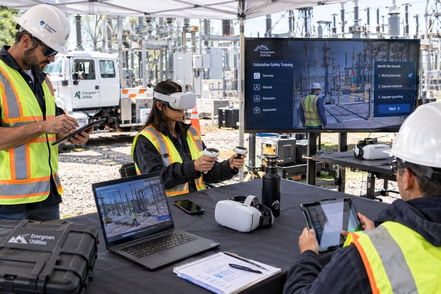
One of the most useful applications of virtual reality in construction is giving employees realistic exposure to environments and situations without exposing them to actual hazards.
A worker can enter a simulated construction environment and practice:
- Hazard identification
- Equipment inspections
- Lockout or safety procedures
- Site orientation
- Working around heavy machinery
- Fall prevention
- Emergency response
- Procedural sequencing
This makes VR particularly relevant for construction safety training.
Traditional safety instruction can explain what workers should do. An immersive simulation can require them to demonstrate that they recognize the problem.
For example, instead of showing an employee a slide describing potential hazards, a simulation could place the employee on a virtual jobsite and ask them to identify unsafe conditions before starting work.
The learner has to observe, decide, and respond.
That is a much closer approximation of the thinking required on an actual jobsite.
Immersive Training Helps Move Safety From Knowledge to Behavior
Many safety programs are designed around knowledge.
Did the employee complete the course?
Did they pass the quiz?
Can they identify the correct procedure?
Those questions matter, but safe work also depends on how employees behave when conditions are less predictable.
An employee may understand a safety policy but still fail to recognize when something has changed in the environment.
Immersive training allows construction organizations to create situations where employees have to make decisions.
What happens if equipment is positioned incorrectly?
What if another worker enters the area?
What if the environment changes halfway through the task?
What if a required step is missed?
The employee can make the wrong decision in a simulation, understand why it was wrong, and repeat the scenario.
That is one of the biggest advantages of experiential workforce skills training.
Employees are not simply being told what good performance looks like. They are practicing it.
Digital Training Tools Can Support Apprenticeship Programs
Apprenticeship remains one of the most valuable forms of construction employee development.
There is enormous value in learning directly from experienced tradespeople and supervisors.
But apprenticeships also face a scaling problem.
The quality of the learning experience can depend heavily on who is available, what project is underway, and which tasks the apprentice happens to encounter.
Digital training tools can help create more structure around that experience.
An apprentice could complete an interactive equipment walkthrough before working alongside an experienced operator.
They could review a simulated procedure before attempting it physically.
They might complete a site-specific training module before arriving at a new project.
This does not replace apprenticeship programs.
It strengthens them.
Digital learning gives the organization a way to standardize foundational knowledge while experienced employees focus their time on coaching, judgment, and practical skill development.
Capture the Knowledge of Experienced Workers
One of the biggest challenges facing construction and industrial organizations is the loss of institutional knowledge when experienced employees retire or leave.
A veteran employee often knows far more than what appears in a procedure manual.
They know which mistakes new workers typically make.
They recognize subtle warning signs.
They understand how actual jobsite conditions differ from ideal scenarios.
They know what to check before beginning a task.
Modern construction employee development should include a strategy for capturing that expertise before it disappears.
Digital and immersive training provide a practical way to do it.
Training teams can work with subject matter experts to identify critical decision points, procedures, common errors, and jobsite scenarios. Those insights can then be turned into interactive learning experiences that can be reused across the organization.
Instead of requiring the same expert to personally teach every new employee, part of that knowledge becomes repeatable.
That helps turn individual experience into organizational capability.
Multi-Device Training Makes Construction Learning Easier to Scale
VR can be extremely useful, but it should not be the only way employees can access immersive training.
Construction companies may have workers in offices, training centers, temporary facilities, remote locations, and active jobsites.
Requiring a headset for every learning experience can create unnecessary barriers.
Modern digital training tools can allow the same learning strategy to reach employees through:
- Desktop computers
- Laptops
- Tablets
- Mobile devices
- 360-degree experiences
- VR headsets
The device should match the training objective.
A new employee might complete a project orientation on a tablet.
A worker could explore an interactive 360-degree site before arriving.
A technician might practice a procedure on a desktop.
A high-risk or spatially complex scenario might justify a VR headset.
This approach makes immersive training easier to deploy across large workforces because the organization is not forced to choose between traditional e-learning and VR.
It can use both.
Digital Tools Can Improve Construction Onboarding
Construction onboarding often has to happen quickly.
Employees need to understand the organization, their role, safety expectations, site requirements, equipment, and procedures before they can become productive.
That creates an opportunity for better digital learning.
Instead of waiting until an employee reaches the jobsite to introduce everything, organizations can move some learning earlier in the process.
Before arriving, an employee might complete:
- Site orientations
- Safety introductions
- Equipment familiarization
- PPE requirements
- Job-specific procedures
- Interactive hazard recognition
- Virtual walkthroughs
This gives supervisors a more prepared employee on day one.
It also creates more consistency across sites.
When every supervisor has to deliver onboarding independently, the training experience can vary significantly. Digital training gives corporate L&D teams a way to establish a common baseline before site-specific instruction begins.
Repetition Makes Difficult Skills Easier to Learn
Some construction tasks are difficult to practice repeatedly.
Equipment may be unavailable.
A specific work condition may happen only occasionally.
Training may interfere with production schedules.
Certain scenarios may be too dangerous to intentionally recreate.
Simulation provides another option.
Employees can repeat parts of a task until the process becomes familiar.
They can work through troubleshooting scenarios.
They can practice recognizing hazards.
They can experience rare events without waiting for those events to occur in real life.
Repetition is especially valuable when an employee understands a concept intellectually but has not yet developed confidence applying it.
This is where immersive learning can complement hands-on instruction.
The physical skill still happens in the real world, but the learner arrives with more familiarity.
Better Training Does Not Mean Replacing the Jobsite
The strongest use of technology in construction training is not replacing hands-on experience.
It is making hands-on experience more valuable.
Consider a new equipment operator.
A traditional approach may involve classroom instruction followed by direct practice with the equipment.
A blended approach might begin with digital learning, followed by an interactive equipment walkthrough, then a simulation, and finally supervised physical operation.
By the time the employee reaches the equipment, they already understand the controls, procedures, hazards, and expected sequence.
The instructor can spend less time explaining the basics and more time coaching performance.
That is a better use of both employee and instructor time.
The Future of Construction Employee Development Is Blended
The future of construction workforce training is unlikely to be completely virtual or completely traditional.
It will be blended.
Classroom instruction will still matter.
Apprenticeships will still matter.
Experienced tradespeople will still be essential.
Physical practice will remain necessary.
But digital tools can make each of those methods easier to scale.
The biggest opportunity is to use technology where it adds something traditional training cannot easily provide: repetition, consistency, realistic decision-making, access to difficult environments, and training that can be delivered across multiple sites.
The question for construction L&D teams should not be:
"How do we replace hands-on training with technology?"
A better question is:
"Where can technology help employees get more meaningful practice before they are expected to perform?"
That shift changes digital training from a technology project into a workforce readiness strategy.
For construction and industrial organizations dealing with skills shortages, safety demands, experienced-worker retirements, and distributed teams, that may be the most important benefit of all.
Frequently Asked Questions
What is construction workforce training?
Construction workforce training includes the learning, skills development, safety instruction, apprenticeship, and practical experience employees need to perform construction work effectively. It can include classroom instruction, digital learning, simulation, hands-on practice, mentorship, and immersive training.
How is VR used in construction training?
VR allows construction employees to practice procedures, recognize hazards, explore jobsites, learn equipment, and experience realistic scenarios in a simulated environment. It is especially useful when the real situation is dangerous, expensive, difficult to schedule, or hard to reproduce.
Can VR replace hands-on construction training?
In most cases, no. VR works best as a complement to hands-on training. It can help employees build familiarity, procedural knowledge, hazard awareness, and decision-making skills before they practice physically on a jobsite or with real equipment.
How do digital training tools support construction safety training?
Digital training tools can create consistent safety instruction across locations and provide interactive scenarios where employees must identify hazards and make decisions. They can also make refresher training and site-specific learning easier to distribute.
How can technology improve apprenticeship programs?
Technology can give apprentices structured learning before and between hands-on experiences. Digital modules, simulations, equipment walkthroughs, and immersive scenarios can reinforce what apprentices learn from experienced workers and provide more consistent exposure to important procedures and situations.
What are the benefits of immersive construction training?
Immersive construction training can provide realistic practice, repetition, consistent instruction, exposure to high-risk scenarios, and more opportunities for employees to make decisions before they face those situations in the field.
Does immersive construction training require a VR headset?
No. Immersive training can be delivered through desktop computers, tablets, mobile devices, 360-degree environments, and VR headsets. Organizations can choose the device and level of immersion that best fits each training objective.
How can construction companies scale employee development across multiple sites?
Construction companies can combine centralized digital content with site-specific training, reusable simulations, mobile learning, apprenticeship programs, and instructor-led practice. This creates a common training foundation while still allowing each site to address local equipment, procedures, and risks.



Comments