TL;DR: Manufacturing is evolving faster than traditional training can keep up. Automation, robotics, labor shortages, and constant process changes require training that is scalable, engaging, and easy to update. The best manufacturing training technologies combine immersive learning, digital content, and hands-on practice to reduce onboarding time, improve retention, and prepare employees for increasingly complex production environments.
Manufacturing has always been about continuous improvement.
Processes become more efficient.
Equipment becomes more advanced.
Automation expands.
Quality standards rise.
Ironically, one area has often struggled to keep pace.
Training.
Many manufacturers still rely on classroom presentations, printed manuals, and shadowing experienced employees. While those methods still have value, they weren't designed for today's manufacturing environment, where procedures change frequently, production schedules leave little room for extended training, and experienced workers are retiring faster than they can be replaced.
Learning and development teams face a difficult challenge.
They need to train larger workforces, across more locations, with fewer instructors and tighter budgets.
Fortunately, manufacturing technology isn't limited to the production floor anymore.
Training technology is evolving just as quickly.
Here are seven of the most impactful technologies transforming manufacturing training in 2026.
1. Immersive Learning Platforms
Perhaps the biggest shift in manufacturing education is the move toward immersive learning.
Instead of reading procedures or watching videos, employees actively perform tasks inside realistic digital environments.
They learn how to:
- Operate equipment
- Complete inspections
- Follow safety procedures
- Troubleshoot machinery
- Respond to emergencies
- Navigate production workflows
Interactive practice improves engagement because employees learn by doing rather than observing.
It also reduces risk by allowing mistakes to happen in simulated environments instead of on expensive production equipment.
For manufacturers, immersive learning offers something traditional instruction often cannot.
Experience before exposure.
2. Interactive 360° Training
Many manufacturing processes depend on understanding physical environments.
Interactive 360° training captures real production floors and transforms them into digital learning experiences.
Employees can explore facilities, inspect equipment, identify hazards, and complete procedural walkthroughs before entering active production areas.
Unlike standard videos, learners interact with the environment.
They choose where to look.
Answer questions.
Follow workflows.
Make decisions.
This creates significantly higher engagement while requiring far less development than fully modeled virtual environments.
3. No-Code Content Creation Platforms
Manufacturing changes constantly.
Production procedures evolve.
Machines are upgraded.
Safety requirements change.
Unfortunately, traditional content development often moves much more slowly.
Waiting months for vendors to update training materials simply isn't practical.
Modern no-code platforms allow subject matter experts, supervisors, and instructional designers to build immersive training without programming.
Instead of relying on software developers, manufacturing experts become training creators.
That keeps learning aligned with operations while dramatically reducing production costs.
4. Mobile and Device-Agnostic Learning
One of the biggest misconceptions surrounding immersive training is that every employee needs a virtual reality headset.
Today's leading platforms are increasingly device agnostic.
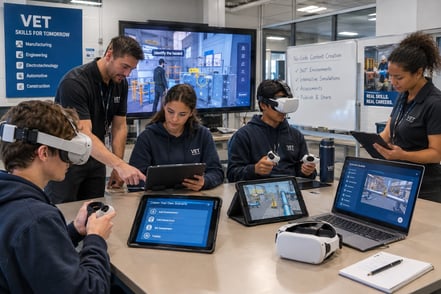
Employees can access the same learning experiences using:
- Desktop computers
- Laptops
- Tablets
- Smartphones
- VR headsets when appropriate
This flexibility makes multi-site training dramatically easier.
Organizations deploy one training program across dozens of facilities without requiring specialized hardware at every location.
Employees learn wherever they happen to be.
5. AI-Powered Learning Support
Artificial intelligence is beginning to play an increasingly important role in manufacturing education.
Rather than replacing instructors, AI helps personalize learning.
Employees receive:
- Targeted recommendations
- Personalized review material
- Adaptive assessments
- Knowledge reinforcement
- Just-in-time guidance
AI can also help identify areas where employees consistently struggle, allowing L&D teams to improve training before small issues become operational problems.
The goal isn't automation for its own sake.
It's helping every learner receive the support they need.
6. Digital Performance Analytics
Historically, manufacturers measured training using simple metrics.
Who completed the course?
Who passed the quiz?
Today's operational training technology provides much deeper insight.
Organizations can evaluate:
- Procedural accuracy
- Decision quality
- Completion time
- Knowledge retention
- Skill progression
- Confidence levels
Instead of measuring participation, manufacturers begin measuring competency.
That provides a much clearer understanding of workforce readiness.
7. Employee-Generated Learning
Perhaps the most important trend isn't a technology at all.
It's a change in who creates training.
Manufacturing organizations employ countless experts who understand production better than anyone else.
For years, sharing that knowledge required instructional designers, developers, or outside vendors.
Today's no-code tools allow experienced employees to create learning directly.
Supervisors document procedures.
Engineers demonstrate equipment.
Operators record best practices.
Safety managers build compliance scenarios.
Training becomes a living resource that evolves alongside production rather than a static library updated once a year.
This approach helps preserve institutional knowledge while dramatically increasing the speed at which learning content can be created.
Why Manufacturing Training Technology Is Changing
These seven technologies appear different on the surface.
Some focus on immersive learning.
Others improve analytics.
Some accelerate content creation.
Others personalize education.
But they all solve the same problem.
Manufacturing is changing faster than traditional training can adapt.
Organizations need learning systems that evolve just as quickly as production lines.
That means training that is:
- Easy to update
- Practical rather than theoretical
- Consistent across locations
- Accessible from multiple devices
- Built around active participation instead of passive observation
Technology isn't replacing instructors.
It's making their expertise easier to scale.
Building the Manufacturing Workforce of Tomorrow
The manufacturing labor shortage isn't likely to disappear anytime soon.
Experienced employees will continue retiring.
Automation will continue expanding.
Production systems will become increasingly sophisticated.
Manufacturers that continue relying exclusively on classroom instruction and outdated training materials will find it increasingly difficult to prepare employees for modern operations.
Those that embrace interactive, immersive, and flexible learning technologies will build workforces that become productive faster, adapt more easily to change, and perform more confidently on the production floor.
The future of manufacturing won't belong only to companies with the newest equipment.
It will belong to companies with the best-trained people.
Frequently Asked Questions
What is the best manufacturing training technology?
There isn't a single best solution. The strongest manufacturing training programs combine immersive learning, interactive 360° content, practical hands-on instruction, mobile learning, performance analytics, and employee-generated content.
Why is immersive learning effective for manufacturing?
Immersive learning allows employees to practice procedures, equipment operation, and safety protocols in realistic environments before working on actual production lines, improving confidence and reducing errors.
What is device-agnostic manufacturing training?
Device-agnostic training delivers the same learning experiences across desktops, laptops, tablets, smartphones, and VR headsets. This makes deployment easier across multiple manufacturing facilities.
How can manufacturers improve multi-site training?
Standardized digital learning platforms allow organizations to deliver consistent training across every facility while still supporting local procedures, equipment, and compliance requirements when needed.
Why is employee-generated learning becoming popular?
Experienced operators and supervisors can create and update training much faster than traditional development teams. This keeps content current while preserving valuable institutional knowledge.



Comments