TL;DR
Utility companies are facing a workforce transformation unlike any in their history. Retirements, evolving technologies, stricter regulations, and increasing infrastructure demands are exposing weaknesses in traditional training programs. The organizations that thrive will shift from static, classroom-based instruction to immersive, scalable, device-agnostic learning that prepares employees for real work before they ever step into the field.
The utility industry has always depended on skilled people.
Whether they're restoring power after a storm, maintaining substations, inspecting gas pipelines, or managing water treatment facilities, utility workers perform some of the most technically demanding and safety-critical jobs in the economy.
The challenge isn't finding more work. Demand continues to grow.
The challenge is preparing enough qualified people to do it.
Utilities across North America are experiencing a convergence of workforce issues that traditional training methods simply weren't designed to solve. While regulations continue expanding and infrastructure becomes more sophisticated, experienced employees are retiring faster than organizations can replace them.
For corporate learning and development teams, the question is no longer whether training needs to change.
It's how quickly they can modernize it.
Here are the biggest utility workforce training challenges organizations are facing in 2026 and what leading companies are doing differently.
1. Losing Decades of Institutional Knowledge
One of the greatest risks utilities face isn't equipment failure.
It's knowledge loss.
Experienced operators, linemen, field technicians, and maintenance specialists often possess decades of practical expertise that exists only in their heads.
They know how systems behave under unusual conditions.
They recognize subtle warning signs before equipment fails.
They understand which procedures work best in situations manuals rarely cover.
When these employees retire, much of that knowledge disappears with them.
Traditional documentation captures procedures.
It rarely captures experience.
Modern training programs increasingly focus on preserving institutional knowledge through interactive scenarios that allow experts to demonstrate—not simply describe—how work gets done.
2. Closing the Technical Skills Gap
The technical skills gap continues widening across nearly every utility discipline.
Today's employees must understand far more than previous generations.
They work with:
- Smart grid technology
- Renewable energy systems
- Distributed generation
- Advanced automation
- Digital monitoring platforms
- Battery storage
- Remote diagnostics
- Cybersecurity protocols
Many new hires enter the workforce with strong technical aptitude but limited field experience.
That means organizations must build competency faster than ever before.
Training has shifted from knowledge transfer to workforce acceleration.
3. Training Safely for Dangerous Work
Few industries involve as much operational risk as utilities.
Employees regularly work around:
- High-voltage electrical systems
- Gas distribution infrastructure
- Heavy machinery
- Confined spaces
- Underground utilities
- Hazardous weather
- Pressurized equipment
The obvious challenge is that employees need realistic practice.
The problem is that creating realistic practice can introduce unnecessary danger.
Nobody wants a trainee learning critical emergency procedures during an actual emergency.
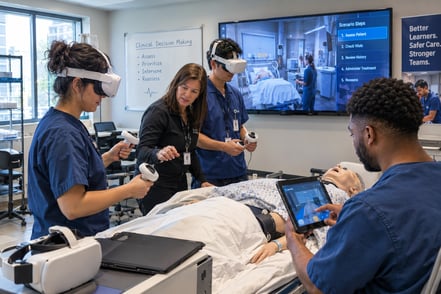
Immersive simulations allow employees to repeatedly practice hazardous situations without placing people, equipment, or infrastructure at risk.
4. Keeping Training Current
Utility procedures rarely remain static.
Equipment changes.
Safety requirements evolve.
Manufacturers release new systems.
Internal best practices improve.
Unfortunately, traditional course development often takes weeks or months.
Many organizations still rely on outside vendors whenever training requires updates.
By the time revisions are complete, operations may have already changed again.
Organizations are increasingly shifting toward self-authored training content that internal subject matter experts can update immediately.
Current training is better training.
5. Scaling Consistent Learning Across Multiple Locations
Many utility companies operate across multiple states, provinces, or service territories.
Providing consistent instruction across dozens or hundreds of locations becomes increasingly difficult.
Different instructors naturally teach differently.
Different facilities often use different examples.
Training quality becomes inconsistent.
Modern learning platforms make standardized training available everywhere while allowing organizations to customize scenarios for regional equipment, procedures, or regulations when necessary.
Consistency improves without sacrificing flexibility.
6. Engaging a New Generation of Workers
The newest generation entering utilities learns differently than previous generations.
They've grown up using smartphones, interactive software, digital media, and on-demand learning.
Static presentations struggle to hold attention.
That doesn't mean younger employees lack focus.
It means they expect participation.
Scenario-based learning, simulations, interactive decision-making, and experiential practice create significantly more engagement than lecture-based instruction alone.
Employees remember experiences far longer than slides.
7. Measuring Competency Instead of Course Completion
Many utility organizations still evaluate training using completion rates.
Did employees finish the course?
Did they pass the quiz?
Those metrics matter.
But they don't answer the most important question.
Can employees actually perform the work?
Leading organizations increasingly measure operational readiness instead of training attendance.
Interactive learning makes this easier by tracking decisions, performance, procedural accuracy, and knowledge application throughout realistic scenarios.
Completion becomes only one measurement among many.
8. Supporting Both Field and Remote Workers
Today's utility workforce isn't confined to one location.
Employees work:
- In substations
- At generating facilities
- In maintenance shops
- From service vehicles
- In corporate offices
- From home
Training must work wherever employees are located.
That's one reason device-agnostic learning has become increasingly valuable.
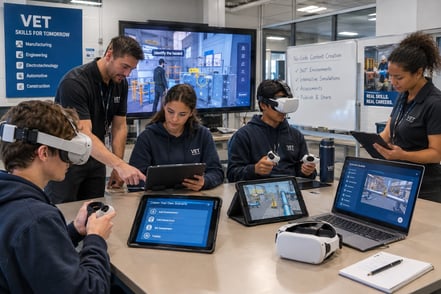
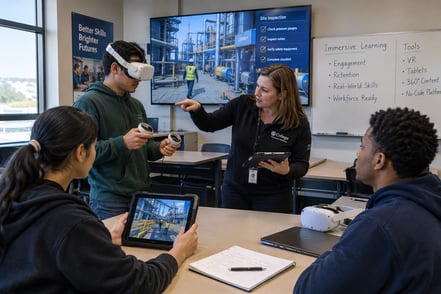
Instead of requiring specialized hardware, organizations can deliver immersive experiences across desktops, laptops, tablets, mobile devices, and VR headsets when appropriate.
Training reaches employees wherever work happens.
9. Improving Employee Retention Through Better Onboarding
Hiring skilled employees has become increasingly difficult.
Keeping them has become just as important.
Poor onboarding creates uncertainty.
Employees feel overwhelmed.
Confidence suffers.
Turnover increases.
Better onboarding shortens the path to productivity.
Interactive practice helps new employees build confidence before facing complex situations in the field.
Organizations that invest in better learning experiences often improve both workforce readiness and long-term retention.
10. Doing More With Smaller Learning Teams
Perhaps the biggest challenge facing corporate learning departments is simple.
Expectations continue growing.
Budgets rarely do.
L&D teams are expected to produce more content, support more employees, update more procedures, and demonstrate greater business impact with limited resources.
The answer isn't hiring dramatically larger instructional design teams.
It's giving subject matter experts the ability to build and maintain training themselves using intuitive, no-code tools.
When the people closest to the work can rapidly create learning experiences, training scales much more effectively.
The Common Thread Behind Every Challenge
Each of these challenges appears different on the surface.
Knowledge retention.
Safety.
Compliance.
Hiring.
Technology.
Employee engagement.
But they all point toward the same underlying issue.
Traditional training methods were designed for a slower-moving industry.
Utilities no longer operate in that world.
Modern organizations need learning that evolves as quickly as their operations do.
That means training that is:
- Interactive instead of passive
- Scenario-based instead of presentation-based
- Easy to update instead of vendor dependent
- Available on any device instead of specialized hardware
- Measured by competency instead of attendance
These capabilities aren't replacing instructors.
They're making instructors more effective.
Looking Ahead
The utility industry will continue changing over the next decade.
Infrastructure investments are increasing.
Electrification is expanding.
Renewable energy adoption continues growing.
Grid modernization remains a priority.
Every one of those trends increases the demand for skilled employees.
Organizations that modernize training today will be better prepared to develop tomorrow's workforce.
The goal isn't simply delivering more courses.
It's creating employees who are confident, competent, and ready to perform safely from day one.
For corporate L&D teams, that may be the most important investment utilities can make.
Frequently Asked Questions
What are the biggest utility workforce training challenges in 2026?
The biggest challenges include retiring employees, the growing technical skills gap, evolving technology, safety training, regulatory compliance, inconsistent training across locations, and the need to onboard new employees more quickly.
Why is workforce development important for utility companies?
Strong workforce development helps utilities prepare employees for increasingly technical roles, preserve institutional knowledge, improve operational safety, and reduce the time it takes for new hires to become productive.
How can immersive learning improve utility training?
Immersive learning gives employees realistic, hands-on practice in safe environments. Interactive scenarios improve engagement, knowledge retention, confidence, and operational readiness compared to traditional lecture-based training.
Does immersive utility training require VR headsets?
No. Many modern platforms deliver immersive learning across desktops, laptops, tablets, mobile devices, and VR headsets, allowing organizations to deploy training without requiring specialized hardware.
How should utility companies measure training success?
Rather than focusing solely on course completion, organizations should evaluate competency, procedural accuracy, decision-making, confidence, knowledge retention, and on-the-job performance.



Comments