Why Organizations Are Moving Beyond Passive Training Toward Learning by Doing
TL;DR
Across industrial sectors, organizations are increasingly recognizing that employees learn most effectively through experience rather than information alone.
Experiential learning is reshaping workforce development by allowing employees to actively practice procedures, workflows, decision-making, and safety protocols in realistic environments before entering live operations.
Immersive learning technologies such as VR and interactive simulations are accelerating this shift by making experiential workforce training scalable, repeatable, and operationally relevant.
As industries face growing workforce turnover, operational complexity, and safety pressures, experiential learning is becoming less of an educational philosophy and more of a strategic workforce readiness capability.
The Problem With Traditional Workforce Training Is Not Information — It’s Application
For decades, most workforce training programs were designed around a relatively simple objective: deliver information efficiently.
Organizations built onboarding systems, compliance modules, SOP documentation, and eLearning platforms intended to transfer knowledge across increasingly large and distributed workforces.
In many ways, those systems accomplished their purpose.
Employees completed certifications. Procedures were documented. Training records were maintained. Compliance requirements were met.
But modern operational environments are revealing the limitations of information-based learning models.
Employees today are expected to operate inside environments defined by:
- Technical complexity
- Safety-critical procedures
- Rapid operational change
- High-pressure decision-making
- Interconnected systems
- Continuous adaptation
In these environments, understanding information theoretically is often not enough.
An employee may know the steps of a procedure intellectually and still struggle to perform it effectively under real operational conditions. A technician may complete safety training while remaining unfamiliar with how hazards emerge contextually in the field. A healthcare worker may memorize emergency protocols but still lack the confidence that only comes through repeated practice.
This gap between information and application is becoming one of the defining workforce development challenges across industrial sectors.
Experiential learning addresses that gap directly.
Because ultimately, workforce readiness is not built solely through information exposure.
It is built through experience.
Why Humans Learn Best Through Experience
Experiential learning is not a new concept.
Long before digital learning systems existed, most workforce expertise developed through observation, repetition, mentorship, and hands-on practice. Employees learned by participating directly in operational environments and gradually building procedural familiarity over time.
That process worked because humans naturally learn best through contextual experience.
People retain knowledge more effectively when they:
- Practice actively
- Make decisions
- Experience consequences
- Solve problems
- Interact with environments
- Repeat procedures
- Apply concepts in context
This is why some of the world’s highest-performing professions have always relied heavily on simulation and rehearsal.
Pilots train in flight simulators before entering live aircraft. Surgeons rehearse procedures repeatedly before operating on patients. Military teams practice under realistic conditions before deployment.
Industrial workforce development is increasingly moving in the same direction.
Organizations are recognizing that employees become operationally prepared not simply by consuming information, but by rehearsing operational reality before consequences emerge in the field.
Why Experiential Learning Is Becoming More Important Now
Several major workforce trends are accelerating the importance of experiential learning simultaneously.
First, operational environments are becoming more complex.
Energy organizations are modernizing infrastructure while integrating renewable systems and advanced grid technologies. Manufacturers are balancing automation with workforce adaptability. Aviation organizations continue operating in highly procedural environments where precision is critical. Healthcare systems face increasing procedural intensity alongside staffing challenges.
Second, workforce transition pressures are intensifying.
Many industries are losing experienced personnel faster than institutional knowledge can traditionally be transferred. Historically, employees developed readiness gradually through extended field exposure and mentorship. But organizations today often have less time available for slow experiential learning.
Third, organizations are under growing pressure to improve both safety and productivity simultaneously.
This creates a difficult tension. Workers need practical experience, but many operational environments are too hazardous, expensive, or disruptive to use as primary learning environments.
Experiential learning technologies solve this problem by allowing organizations to create realistic rehearsal environments without introducing real-world operational risk.
This is one reason immersive learning and simulation-based training are accelerating so rapidly across industrial sectors.
How Immersive Learning Expands Experiential Training
Historically, experiential learning was difficult to scale.
Hands-on training often required:
- Physical equipment
- Instructor availability
- Operational downtime
- Access to facilities
- Live practice environments
- Significant scheduling coordination
Some scenarios were simply too dangerous or disruptive to recreate frequently.
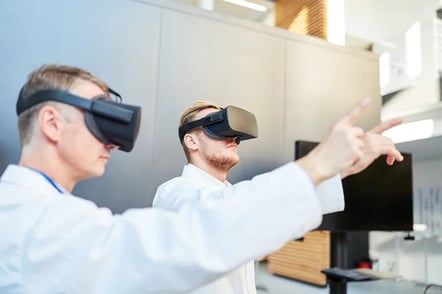
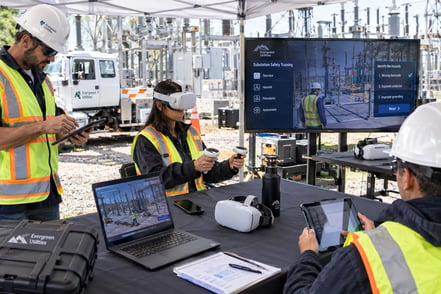
Immersive technologies such as VR and interactive simulation training fundamentally change that equation.
Organizations can now recreate:
- Facilities
- Equipment
- Hazardous environments
- Emergency procedures
- Maintenance workflows
- Operational tasks
- Customer interactions
- Safety scenarios
Inside realistic digital environments where employees can practice repeatedly without operational consequences.
This transforms experiential learning from an occasional training event into a scalable workforce development system.
More importantly, immersive simulations allow organizations to preserve operational context during learning.
Employees are not simply reading about procedures abstractly. They are learning inside environments that mirror the conditions where those procedures will ultimately be executed.
That contextual realism dramatically improves:
- Knowledge retention
- Situational awareness
- Procedural confidence
- Workforce engagement
- Decision-making readiness
The result is not simply more engaging learning.
It is more operationally transferable learning.
Experiential Learning Is Reshaping Workforce Readiness
One of the most significant shifts happening right now is that organizations are beginning to rethink what workforce readiness actually means.
Historically, readiness was often associated with:
- Certification completion
- Training attendance
- Assessment scores
- Compliance status
But operational readiness increasingly depends on something deeper:
behavioral preparedness inside real environments.
Experiential learning helps employees build:
- Environmental familiarity
- Procedural confidence
- Cognitive readiness
- Operational awareness
- Human performance consistency
This is especially important in industries where operational mistakes carry serious consequences.
A worker performing a lockout/tagout procedure, a healthcare professional responding to an emergency, or a maintenance technician troubleshooting critical equipment all depend heavily on experiential familiarity—not simply theoretical understanding.
Immersive workforce development systems allow organizations to create that familiarity proactively before employees encounter real-world operational pressure.
In many ways, experiential learning is becoming the bridge between workforce training and workforce performance.
The Future of Workforce Development Will Be Experiential
The organizations leading workforce transformation today are increasingly building systems designed around continuous experiential learning rather than static content delivery alone.
This reflects a broader realization:
Operational environments evolve constantly, and workforce learning must evolve alongside them.
Procedures change. Equipment changes. Technologies advance. Risks emerge. Workforce compositions shift continuously.
As a result, workforce readiness cannot remain dependent solely on one-time onboarding or periodic compliance refreshers.
Experiential learning platforms allow organizations to create adaptive rehearsal environments that continuously reinforce operational capability over time.
This makes workforce development more dynamic, scalable, and operationally aligned.
Most importantly, it allows organizations to prepare employees for complexity before operational consequences emerge.
That capability may ultimately become one of the defining workforce advantages of the next decade.
Final Thoughts
Experiential learning is rapidly becoming one of the most important shifts happening in workforce development.
The reason is simple:
People learn most effectively through experience.
Modern industrial organizations are increasingly recognizing that operational readiness requires more than information delivery alone. It requires realistic rehearsal, contextual learning, and repeated operational exposure.
Immersive learning and interactive simulation training are powerful because they allow organizations to scale experiential workforce development safely, efficiently, and continuously.
The organizations embracing experiential learning today are not simply modernizing training.
They are building more adaptable, confident, and operationally prepared workforces for the future.
FAQ
What is experiential learning?
Experiential learning is a training approach where employees learn through active participation, practice, reflection, and real-world application rather than passive instruction alone.
Why is experiential learning effective?
Experiential learning improves retention, confidence, situational awareness, and operational preparedness because employees actively practice skills and procedures in realistic contexts.
How does immersive learning support experiential workforce development?
Immersive learning uses technologies such as VR and interactive simulations to create realistic digital environments where employees can safely rehearse operational tasks and scenarios.
What industries use experiential learning?
Industries including energy, manufacturing, aviation, healthcare, construction, and education use experiential learning for workforce readiness, onboarding, operational training, and safety preparedness.
What is simulation-based experiential learning?
Simulation-based experiential learning places employees inside realistic digital environments where they actively practice workflows, procedures, communication, and operational decision-making.
Why are organizations moving beyond traditional eLearning?
Traditional eLearning is often passive and disconnected from operational reality. Experiential learning improves workforce readiness through active participation and realistic practice.
Can experiential learning integrate with enterprise LMS systems?
Yes. Many immersive learning platforms support SCORM and xAPI integration with enterprise LMS and workforce analytics systems.
What are the business benefits of experiential learning?
Organizations use experiential learning to improve workforce readiness, accelerate onboarding, strengthen safety preparedness, improve retention, reduce operational risk, and scale workforce development more effectively.




Comments