TL;DR: Healthcare professionals don't become competent by watching PowerPoint presentations—they become competent by practicing. The most effective healthcare training programs combine classroom instruction with hands-on learning that builds confidence, clinical judgment, and procedural competence. From simulation labs to immersive digital scenarios, these seven training methods help healthcare organizations prepare clinicians faster, more safely, and with better long-term retention.
Healthcare is unlike almost any other industry.
Mistakes have consequences.
Procedures change rapidly.
Technology evolves constantly.
Every decision can affect patient outcomes.
That reality creates an enormous challenge for learning and development teams. Healthcare professionals must master increasingly complex clinical skills while maintaining strict compliance standards, adapting to new technologies, and delivering consistent patient care.
Traditional classroom instruction remains valuable for introducing concepts, but no one wants a nurse performing a procedure for the first time on a real patient simply because they watched a presentation the week before.
Healthcare has always been a profession built on practice.
The question isn't whether employees need hands-on learning.
It's how organizations can deliver enough of it without overwhelming instructors, disrupting operations, or putting patients at unnecessary risk.
Here are seven of the most effective healthcare training methods organizations are using in 2026.
1. Simulation-Based Clinical Training
Simulation has become one of the most valuable tools in modern medical education.
Rather than waiting for specific patient scenarios to occur naturally, organizations recreate them in controlled environments.
Clinicians practice:
- Emergency response
- Medication administration
- Patient assessment
- Team communication
- Clinical decision making
- Critical care procedures
Because simulations can be repeated, learners build confidence through experience instead of observation.
Perhaps most importantly, mistakes become learning opportunities instead of patient safety incidents.
Simulation shortens the distance between theory and practice.
2. Immersive VR and 360° Learning Experiences
Virtual reality has matured considerably over the past several years.
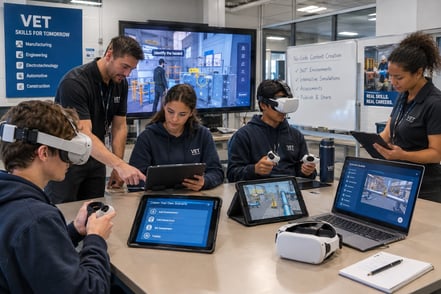
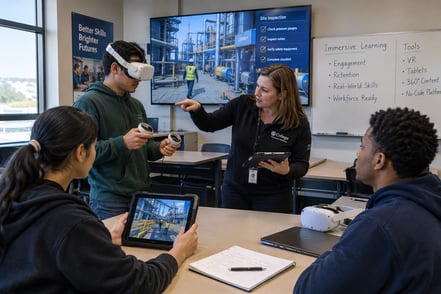
Today's immersive platforms allow clinicians to practice realistic patient interactions, procedural workflows, and emergency situations before encountering similar cases in the real world.
Interactive 360° environments let learners explore operating rooms, emergency departments, laboratories, patient rooms, and clinical workflows while making decisions throughout the experience.
Many organizations assume immersive learning requires VR headsets.
Increasingly, that's no longer true.
Modern platforms often support desktops, tablets, mobile devices, and VR from the same training content, making immersive learning far more practical to deploy across healthcare organizations.
3. Skills Labs and Practical Demonstrations
Despite advances in educational technology, physical skills laboratories remain essential.
Practicing with real medical equipment helps learners develop:
- Fine motor skills
- Equipment familiarity
- Procedural confidence
- Clinical workflow understanding
The most effective programs don't replace labs with digital experiences.
They combine them.
Students often arrive at the lab after completing immersive digital scenarios, allowing instructors to spend more time coaching technique instead of explaining basic procedures.
Technology prepares learners.
Instructors refine performance.
4. Scenario-Based Decision Training
Not every clinical decision involves technical procedures.
Healthcare professionals constantly make judgments under pressure.
Prioritizing patients.
Recognizing deteriorating conditions.
Communicating with families.
Escalating care.
Managing multiple competing priorities.
Scenario-based learning places learners inside realistic situations where every decision influences what happens next.
Rather than memorizing protocols, clinicians learn to apply knowledge in context.
This type of hands-on training develops critical thinking alongside technical competence.
5. Peer Learning and Collaborative Team Training
Healthcare is fundamentally collaborative.
Patient outcomes often depend on communication between physicians, nurses, therapists, pharmacists, technicians, and support staff.
Training should reflect that reality.
Team-based simulations improve:
- Communication
- Leadership
- Coordination
- Role clarity
- Situational awareness
Interdisciplinary practice helps healthcare professionals understand how their decisions affect the broader care team.
These soft skills often prove just as important as technical knowledge.
6. Microlearning Reinforced by Practice
Healthcare professionals rarely have hours available for lengthy classroom sessions.
Microlearning delivers focused lessons that fit naturally into busy clinical schedules.
Short modules review:
- New procedures
- Updated regulations
- Equipment changes
- Medication protocols
- Safety reminders
On their own, however, short lessons have limitations.
Their real value comes when immediately reinforced through practical exercises or immersive scenarios.
Learning remains fresh because employees apply it immediately.
7. Employee-Created Training Content
Healthcare changes constantly.
New equipment arrives.
Protocols evolve.
Clinical guidelines are updated.
Waiting months for outside vendors to revise learning materials no longer makes sense.
Modern no-code authoring platforms allow educators, nurse educators, and subject matter experts to create and update training themselves.
Internal experts can rapidly develop:
- Procedure walkthroughs
- Interactive scenarios
- Equipment orientations
- Compliance updates
- Department-specific workflows
This keeps training aligned with current clinical practice rather than outdated documentation.
Knowledge stays inside the organization instead of depending entirely on external developers.
Why Hands-On Healthcare Training Works
Each of these approaches looks different.
Some involve simulation.
Others rely on collaboration.
Some use immersive technology.
Others focus on instructor coaching.
Yet they all share one important characteristic.
They require learners to participate.
Research consistently shows people retain significantly more information when they actively perform tasks rather than simply observe them.
Healthcare professionals gain confidence through repetition.
Not presentations.
The objective isn't helping employees pass exams.
It's preparing them to make sound clinical decisions when patients need them most.
Building Better Healthcare Organizations Through Better Training
Every healthcare organization wants the same outcomes.
Safer patient care.
Confident clinicians.
Faster onboarding.
Higher employee retention.
Better compliance.
Improved operational efficiency.
Training influences every one of those objectives.
Organizations that rely exclusively on annual compliance modules and classroom presentations will continue struggling to prepare clinicians for increasingly complex healthcare environments.
Those that invest in interactive, practical, and immersive learning create professionals who arrive better prepared for real patient care.
That's not because technology replaces great educators.
It's because great educators finally have tools that better reflect how people actually learn.
Frequently Asked Questions
What is the best healthcare training method?
There is no single best method. The most effective healthcare training combines classroom instruction with simulation, immersive learning, practical skills labs, scenario-based decision making, and ongoing hands-on practice.
Why is hands-on training important in healthcare?
Hands-on training helps healthcare professionals build procedural competence, confidence, critical thinking, and long-term knowledge retention while reducing the risk of errors in real clinical environments.
Does immersive healthcare training require VR headsets?
No. Many modern immersive learning platforms deliver interactive experiences on desktops, laptops, tablets, mobile devices, and VR headsets, allowing healthcare organizations to scale training without specialized hardware.
How can healthcare organizations improve clinical skills training?
Organizations can improve clinical skills by combining instructor-led education with simulations, scenario-based learning, practical exercises, collaborative team training, and easily updated digital learning content.
Can no-code platforms help healthcare educators?
Yes. No-code authoring platforms allow nurse educators, instructional designers, and subject matter experts to create and update immersive training without programming, making learning faster to develop and easier to maintain.


Comments