


Artificial Intelligence (AI) is poised to fundamentally reshape how immersive training content is created, deployed, and optimized across the energy sector. What once required specialist developers, months of production, and significant capital investment can now be accelerated, simplified, and scaled through AI-driven tools.
AI will reduce creation complexity and time, improve instructional design quality, enable adaptive learning pathways, convert 2D images into 360° environments, and dramatically democratize immersive content production. For energy enterprises facing workforce shortages, regulatory pressure, and rapid infrastructure evolution, this shift represents more than efficiency—it represents strategic agility.
Research from the VR/AR Association highlights the growing need for immersive training to address safety, compliance, and staffing challenges . Meanwhile, industry surveys confirm that training remains the primary driver of XR adoption . AI now removes many of the historical barriers that slowed that adoption.
The future of immersive learning in energy is not just virtual—it’s intelligent.
The Evolution of Immersive Creation: From Specialist to Scalable

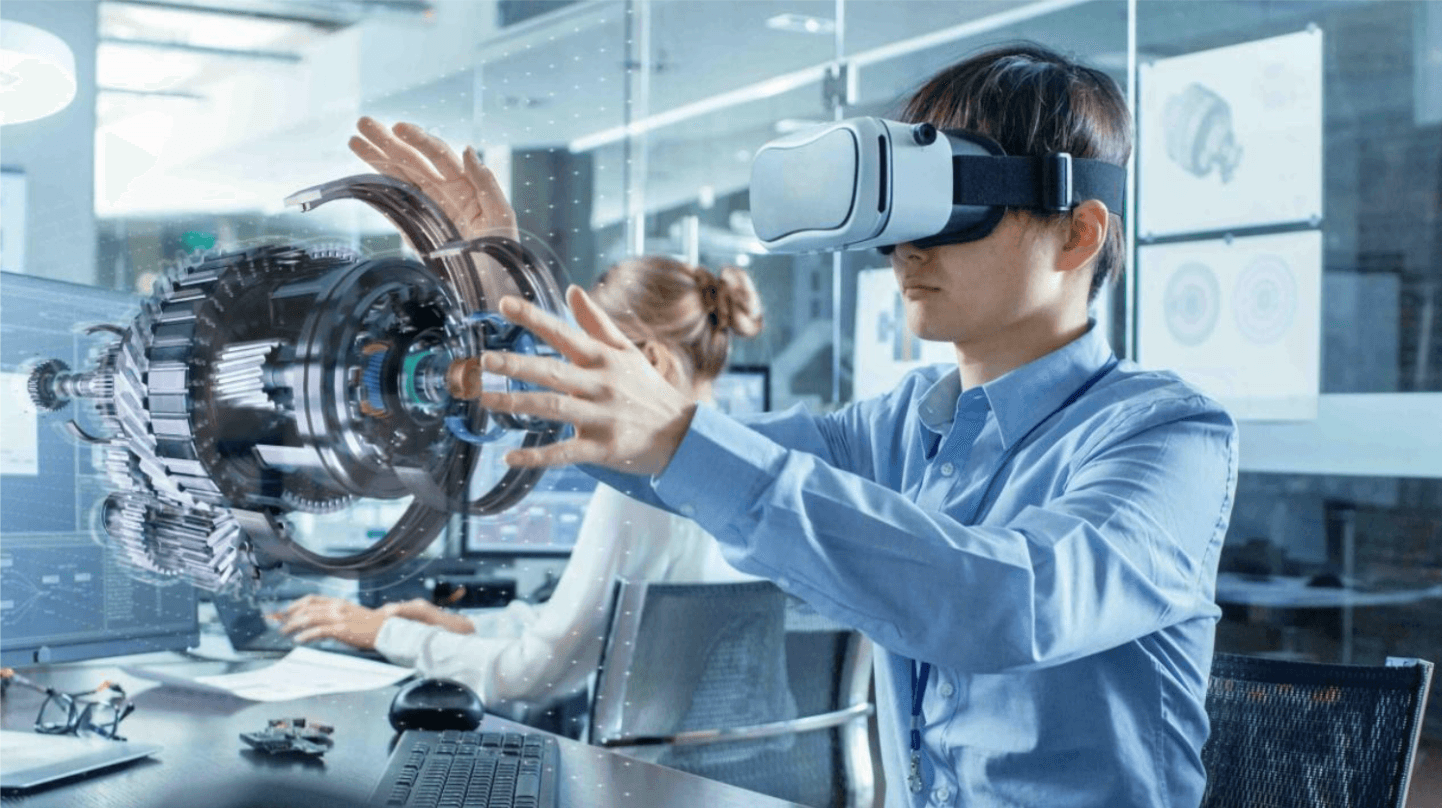


Traditional immersive content creation has relied on:
- 3D modeling specialists
- Game-engine developers
- External content studios
- Long production cycles
This model limited scalability, especially for site-specific energy training. According to the VR/AR Association Energy White Paper, energy operations demand highly specific, contextualized training across complex systems . Custom VR builds often struggled to keep pace with operational change.
AI changes that equation.
1. Reduced Creation Complexity and Time
AI-assisted authoring tools will:
- Auto-generate interactive scenarios from procedural documents
- Convert written SOPs into immersive simulations
- Suggest hazard identification hotspots in 360° environments
- Generate realistic dialogue for role-play simulations
This dramatically reduces production timelines from months to weeks—or even days.
In a sector where regulatory updates (OSHA, NFPA, NERC) require frequent training adjustments, AI enables rapid iteration without costly redevelopment .
For distributed utilities or renewable operators, this means faster deployment of updated substation procedures, turbine maintenance simulations, or carbon capture protocols.
2. AI-Enhanced Learning Design & Adaptive Learning
One of the most powerful impacts of AI will be on instructional quality—not just speed.
The VR/AR Association emphasizes the importance of proper learning objective design in immersive deployments . Poor instructional design can undermine even the most advanced XR hardware.
AI can improve learning design by:
- Recommending SMART learning objectives
- Identifying cognitive overload risks
- Suggesting scenario branching for higher-order thinking
- Aligning simulations to competency frameworks
More importantly, AI enables adaptive learning.
Instead of static simulations, immersive experiences can:
- Adjust difficulty based on user performance
- Offer additional guidance to struggling learners
- Introduce unexpected emergency variables for advanced users
- Customize content by role, location, or certification level
Adaptive immersive learning is particularly powerful for energy workforces spanning apprentices, field technicians, and senior engineers.
3. Generating 360° Environments from 2D Imagery
Emerging AI tools can convert 2D photographs into immersive 360° environments. Platforms like Marble demonstrate how AI can extrapolate depth, texture, and environmental context from flat images.
For energy enterprises, this capability means:
- Turning smartphone site photos into immersive induction modules
- Rapidly digitizing remote assets
- Creating hazard simulations without full photogrammetry scans
- Scaling content creation across hundreds of locations
This dramatically lowers the barrier to immersive adoption.
Previously, creating a 360° refinery environment required specialized capture equipment and stitching software. AI shortens that path significantly.
4. Democratization of Immersive Content Creation
The energy sector faces a well-documented staffing challenge, including retiring experts and knowledge loss . Immersive training must scale faster than traditional content pipelines allow.
AI further democratizes content creation by:
- Enabling SMEs to generate draft simulations
- Reducing reliance on bespoke external studios
- Automating environmental asset creation
- Allowing rapid localization and language translation
Combined with no-code immersive platforms , AI shifts control from developers to operational experts closest to risk.
This reduces cost per module while increasing volume and relevance.
5. Rapid Iteration and Greater Content Flexibility
Energy operations are dynamic:
- Grid modernization projects
- New renewable installations
- Carbon capture facility rollouts
- Equipment upgrades
Traditional immersive content often became outdated quickly due to redevelopment costs.
AI enables:
- Fast content edits
- Automated update suggestions
- Scenario regeneration when regulations change
- Performance data analysis to refine simulations
This creates a continuous improvement loop.
Interactive Simulation Training frameworks already emphasize future-proofed, cross-device delivery . AI accelerates that flexibility exponentially.
Strategic Implications for Energy Enterprises
AI will not replace immersive platforms—it will enhance them.
Energy organizations that integrate AI into immersive creation will benefit from:
- Lower content production costs
- Faster time-to-deployment
- More personalized learning experiences
- Improved compliance readiness
- Higher workforce confidence and retention
In high-consequence environments like oil & gas, utilities, renewables, and nuclear, speed and adaptability are competitive advantages.
FAQ
How will AI reduce immersive content creation time?
AI can auto-generate environments, dialogue, assessments, and scenario logic from existing documents, reducing manual development effort.
Will AI replace instructional designers?
No. AI enhances learning design by offering recommendations and automation, but expert oversight remains critical—especially in safety-critical energy environments .
Can AI create 360° environments from regular photos?
Yes. AI tools can extrapolate depth and environmental context from 2D imagery, enabling rapid 360° scene generation (e.g., Marble).
What is adaptive learning in immersive training?
Adaptive learning adjusts simulation difficulty and content pathways based on user performance, improving retention and skill mastery.
Does AI reduce the need for custom-built VR modules?
Yes. AI combined with no-code immersive platforms reduces reliance on expensive bespoke development while maintaining customization .
Is AI-powered immersive training safe for regulated industries?
When aligned with strong instructional design and compliance frameworks, AI can enhance safety and auditability .
Comments