If you lead training for field teams, you already know the dirty secret of “modern” training: it often assumes your workforce sits at desks, on the same schedule, with the same access to tools, and the same patience for corporate learning portals.
Meanwhile, your reality looks more like this: crews in trucks, technicians hopping between sites, supervisors covering multiple regions, and new hires joining in waves that never quite line up. Your operation is distributed by default, even if your org chart pretends otherwise.
That’s why distributed workforce training has one unbeatable requirement: it has to work anywhere, anytime, on the devices people actually have.
And that is exactly why immersive learning without VR is not a downgrade. It’s the smartest way to build a training program that scales across a distributed workforce.
VR is an option, not a requirement. For most enterprise rollouts, that is the winning mindset.
The real bottleneck is not content. It is access.
You can have the best training module in the world, and it still fails if learners cannot easily get to it.
Headsets create friction. Not always, and not forever, but definitely at the start.
- Hardware has to be purchased, managed, sanitized, stored, shipped, tracked.
- Sessions have to be scheduled, facilitated, and supervised.
- A pilot often becomes “the headset room” instead of “the new standard.”
Desktop and tablet access eliminates most of that friction in one move. Put simply, cross-platform training tools widen the front door.
And behavior supports this approach. Gallup reports that remote-capable workers make up about half of the U.S. workforce, and hybrid remains the predominant model for those roles. (Gallup.com) Even if your field employees are not “remote” in the Zoom sense, the broader trend is clear: work is increasingly distributed, and training has to match that distribution.
So if your workforce is spread across territories, sites, plants, or regions, you do not need a headset-first strategy. You need an access-first strategy.
Why immersive learning without VR works so well for field teams
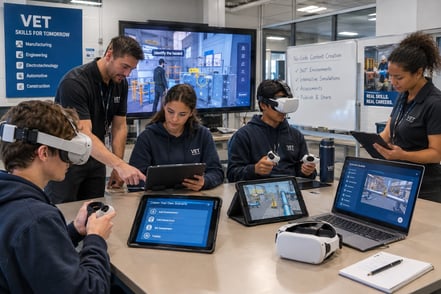
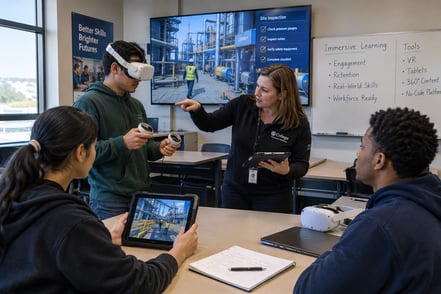
Let’s define what we mean by immersive here. Immersive training is not limited to VR. Immersive is about realism, interactivity, and decision-making. It is training that feels like work, not like reading about work.
You can absolutely deliver that through:
- Interactive desktop simulations
- Scenario-based modules on tablets
- Click-through decision trees that mimic real workflows
- “Choose your next step” safety moments that punish bad assumptions safely
That is tablet-based simulation training in its sweet spot: hands-on learning without the hardware overhead.
And because tablets and laptops are already part of many field operations, you can roll this out with dramatically less resistance than a full headset deployment.
Remote safety training: where flexibility becomes a business decision
In high-risk industries, training is not just an HR initiative. It’s operational risk management.
The National Safety Council estimates the total cost of work injuries in 2023 was $176.5 billion. (Injury Facts) That number is big enough to make any CFO suddenly care about “training modernization.”
Now connect the dots: if your training program cannot reach people consistently because it depends on a headset schedule, you’re leaving preventable risk on the table.
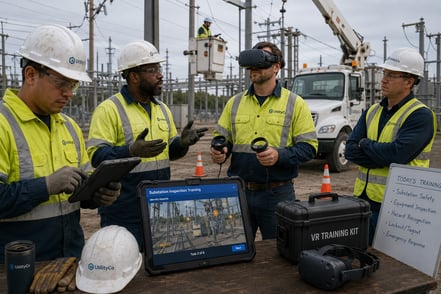
This hits especially hard in utilities and energy, where work is physical, distributed, and often hazardous. Industry analyses citing BLS data point to persistent safety challenges in utilities, including notable fatality rates over multi-year periods. (Urbint) Whether you’re in traditional utilities or renewables, the onboarding reality is the same: new hires need to learn fast, and refreshers need to happen often.
The winning move is delivering remote safety training and competency practice through mobile-friendly, cross-platform delivery that people can actually access during the flow of work.
The “anywhere” advantage is also the “repeatable” advantage
A lot of training fails because it’s treated like an event.
Field teams do not need more events. They need repeatable practice.
That is where mobile-friendly learning tools and desktop-first simulations shine:
- A five-minute refresher before a high-risk task
- A quick scenario review when conditions change (weather, equipment, site rules)
- A just-in-time module for a new procedure
- A consistent onboarding experience across regions
When training is accessible, repetition becomes normal. And repetition is where competence is built.
But what about VR’s benefits?
VR is powerful. No argument. In fact, PwC’s research found VR learners completed training up to 4x faster than classroom learners and felt 3.75x more emotionally connected to the content than classroom learners. (PwC)
So yes, VR can be a rocket booster.
But a rocket booster is useless if you cannot get the plane down the runway.
A headset-first program often stalls before scale. A cross-platform program gets adopted, produces data, proves outcomes, and then adds VR where it makes the most sense.
That is the grown-up approach.
The enterprise rollout that actually works
If you want distributed workforce training that can scale across business units and regions, here’s a rollout strategy that is both practical and ambitious.
1) Start with desktop and tablet for immediate coverage
Use immersive learning without VR to reach the widest audience first. Make the first wave about high-frequency training needs:
- Safety fundamentals and hazard recognition
- Equipment walkarounds and standard procedures
- Energy industry onboarding basics and role readiness
- Incident response checklists and decision-making
2) Build scenarios that mirror real work
The “immersive” part comes from decision points:
- What would you do next?
- What did you miss?
- Which hazard is most likely here?
- What is the correct sequence?
This is where tablet-based simulation training becomes more than “eLearning on a smaller screen.” It becomes practice.
3) Measure behavior, not just completion
Completion rates are table stakes. What matters is:
- Choices made in scenarios
- Time-to-competency trends
- Repeat attempts and improvement
- Common failure points by role, region, or team
This becomes your evidence for leadership that immersive training is improving readiness.
4) Add VR where it pays off
Once you’ve validated content and built internal trust, introduce VR for the highest-impact moments:
- High-risk safety scenarios
- Complex equipment tasks
- Rare but critical incidents
- Situations where spatial realism changes performance
VR becomes an option that strengthens the program, not a dependency that limits it.
The bottom line: Platform flexibility is the strategy
If you serve field teams in utilities, renewables, energy, or any distributed operation, your training platform has to meet people where they are. That means cross-platform training tools that work on desktop and tablet from day one.
The fun part is that this approach does not make training less immersive. It makes it more real.
Because real training is the training people actually complete, repeat, and use to make better decisions on the job.
And once you have that foundation, VR stops being the starting line and becomes what it should be: the high-impact upgrade.



Comments