If you’ve ever tried to roll out immersive training in a real enterprise, you’ve probably lived this sequence:
- Someone sees a VR demo and declares, “This is the future.”
- A pilot launches, a few people love it, and everyone takes photos.
- Then reality arrives: headsets are scarce, schedules get messy, IT asks hard questions, and the program stalls.
That is why blended immersive learning is the strategy that actually scales.
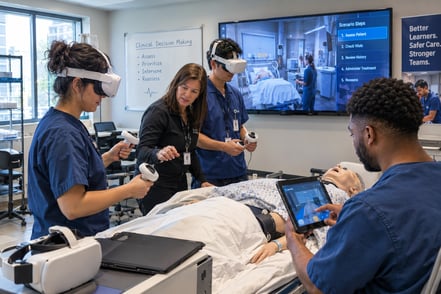
The most effective modern programs do not treat VR as the starting point or the entire solution. They treat immersive learning like a system: desktop and tablet simulations for broad coverage, plus VR for high-stakes moments where full immersion changes behavior.
It’s not less ambitious. It’s more mature.
And it matches what the enterprise training market is signaling. Corporate e-learning is a huge and fast-growing category, with estimates placing it at roughly $104.32B in 2024 and $125.61B in 2025, continuing upward toward 2030. (Grand View Research) That growth is not driven by novelty. It’s driven by scale, speed, and proof.
So let’s build a practical framework your team can actually execute, a cross-platform training strategy that gets adoption quickly and still delivers the wow factor when it matters.
Why blended wins: it solves the enterprise problem, not the demo problem
Blended learning has been studied extensively, and meta-analyses generally show it can improve performance and achievement compared to single-modality approaches in many contexts. (PMC)
Now translate that into enterprise terms:
- Your learners are not all in the same place.
- Your roles are not all the same.
- Your risks are not evenly distributed.
- Your devices are not standardized to one headset.
A blended strategy gives you three big advantages:
1) Access at scale (desktop and tablet)
Desktop and tablet delivery removes the biggest friction point in immersive rollouts: getting people in the experience. That’s how you win adoption.
2) Intensity when it counts (VR)
VR is the power tool for training moments where realistic immersion changes decision-making, muscle memory, or emotional readiness.
3) Consistency across teams and sites (platform delivery)
A blended approach creates one training “language” across devices, rather than a pile of separate programs that never fully connect.
The blended immersive learning model that works
Think in three layers. This is the simplest way to build a hybrid learning enterprise program without getting lost in tools and buzzwords.
Layer 1: Desktop simulations for the baseline
This is where most of your training volume should live, because it’s where you get the fastest coverage.
Use desktop for:
- onboarding and role readiness
- standard operating procedures
- process training that needs repetition
- scenario-based decision practice for common situations
Desktop wins because it is instantly available to the largest group, and it is easy to update and iterate.
Layer 2: Tablet training simulations for in-the-flow learning
Tablets are your bridge between “training” and “work.” They travel. They work in the field. They fit the reality of distributed teams.
Use tablets for:
- job aids that include interactive practice
- refreshers before high-risk tasks
- field checklists with embedded decision points
- supervisor-led micro-simulations during huddles
In energy and utilities, this becomes a serious advantage for energy sector onboarding and refresher training, because you can deploy consistent content across sites without waiting for the “VR day.”
Layer 3: VR and desktop training together for high-stakes mastery
Now we bring in VR, but only where it earns its keep.
Use VR for:
- hazard recognition and high-risk safety scenarios
- rare but critical incidents (the ones you cannot practice safely in real life)
- complex equipment interactions where spatial understanding matters
- soft skills under pressure (de-escalation, leadership moments, difficult conversations)
PwC’s research on VR training is often quoted for good reason. Their study reports that VR learners completed training up to 4x faster than classroom learners and felt 3.75x more emotionally connected to the content than classroom learners. (PwC)
That’s the argument for VR as a multiplier. But the blended strategy is what ensures you can deploy training to everyone, not just the people who can get a headset.
The phased rollout plan: a flexible learning rollout you can defend to leadership
Here’s a phased approach that protects your program from pilot purgatory.
Phase 1 (Weeks 1 to 4): Start with desktop and tablet
Pick one high-value workflow and build:
- an onboarding simulation
- a “day in the life” scenario module
- a short assessment that captures decisions, not just completion
Your goal: prove adoption and collect performance data fast.
Phase 2 (Weeks 5 to 8): Expand coverage and standardize modules
Build a repeatable module template:
- intro context
- scenario
- decision points
- feedback
- retry logic
- assessment
This is where a platform approach matters most. If every module is handcrafted chaos, scale dies quickly.
Phase 3 (Weeks 9 to 12): Add VR for the top 10 percent of scenarios
Choose the scenarios with the highest cost of failure and the highest value of realism.
If you’re in utilities compliance training or safety-heavy industries, the value is obvious. The National Safety Council estimates the total cost of work injuries in 2023 was $176.5 billion. (Injury Facts) That’s the business case for investing in training that reduces incidents and improves readiness, but only if it can reach people consistently.
Phase 4 (Ongoing): Measure, optimize, and scale by role
This is where blended immersive learning becomes a true operating system for training:
- dashboards for scenario outcomes
- time-to-competency by role
- common failure patterns by region or site
- targeted refreshers based on performance gaps
What to measure so “training ROI immersive” is real, not rhetorical
If you want budget holders to stay on your side, measure what they care about:
- Time to proficiency: how quickly new hires reach baseline readiness
- Error reduction: fewer mistakes in the steps that matter most
- Incident indicators: near-miss reporting trends, safety observation scores, compliance findings
- Scenario performance: decision quality over time, not just course completion
- Operational consistency: fewer “local variations” in critical processes
The hidden advantage of blended is volume. Desktop and tablet drive participation. That participation drives data. That data drives optimization. That is how you create repeatable ROI.
Where Facilitate fits in this blended reality
A blended strategy only works if your platform supports it. That means:
- one approach to building content, not separate tools per device
- cross-platform training strategy by design
- ability to start with desktop and tablet, then add VR without rebuilding everything
- fast iteration so training stays current
That’s exactly why the best enterprise programs are moving toward immersive training platforms rather than VR-only deployments. They want flexible learning rollout paths that match real-world constraints, without giving up the upside of VR.
The takeaway
If you want maximum impact, don’t choose between desktop, tablet, and VR.
Use each one like a professional:
- Desktop for coverage and repeatable practice
- Tablet for field reality and just-in-time reinforcement
- VR for high-stakes mastery where realism changes outcomes
That’s blended immersive learning done right, and it’s how modern enterprises scale immersive training without waiting for “full VR saturation” that may never come.
Citations and sources
- PwC (UK) immersive learning effectiveness study
Used for: the VR impact stats referenced as benchmarks for when VR is most valuable in a blended program, including “4x faster” completion and “3.75x more emotionally connected” comparisons.
- PwC (US) virtual reality soft skills training summary
Used for: additional confirmation of the “up to four times faster” finding and related VR effectiveness framing.
- National Safety Council (NSC) Injury Facts, Work Injury Costs (2023)
Used for: the claim that “the total cost of work injuries in 2023 was $176.5 billion,” supporting the business case for scalable safety and readiness training.
- Grand View Research, Corporate E-learning Market report
Used for: the market-sizing figures referenced (e.g., corporate e-learning estimated at $104.32B in 2024, with continued growth projected through 2030), supporting the “training at scale” macro context.
- Yu (2022), “Meta-analyses of differences in blended and traditional learning outcomes” (PMC / open-access)
Used for: the general evidence claim that blended learning outcomes tend to be significantly higher than traditional learning, supporting the rationale for a blended immersive approach.
- Means et al. (2010), U.S. Department of Education meta-analysis of online and blended learning Used for: foundational evidence that blended (hybrid) learning conditions can outperform traditional face-to-face instruction in aggregated studies, reinforcing the blended strategy argument.





Comments