


For years, one of the biggest barriers to immersive and interactive training adoption in the energy sector has been cost and complexity. Custom simulation modules often required external studios, 3D developers, long production timelines, and significant capital investment. While the impact of immersive learning was compelling, the development model was not always scalable.
Artificial Intelligence (AI) is changing that equation.
AI-assisted content creation dramatically reduces development time, lowers production costs, improves instructional quality, and enables rapid iteration. Instead of relying solely on bespoke, studio-built modules, energy organizations can increasingly leverage intelligent automation to accelerate simulation design and deployment.
Research from the Industrial XR Forum confirms that safety, efficiency, and cost savings are primary drivers for immersive adoption . Meanwhile, the VR/AR Association highlights the importance of scalable immersive methodologies in complex energy environments .
AI is not replacing immersive training—it is making it operationally viable at scale.
The Historical Challenge: Bespoke Immersive Development

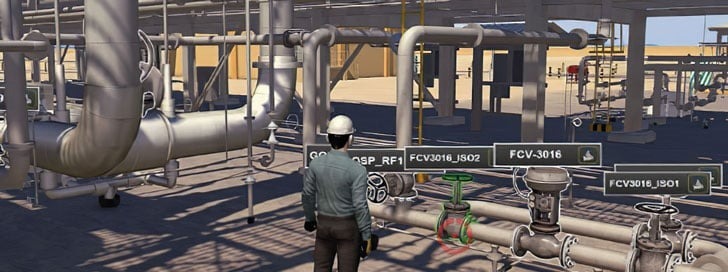
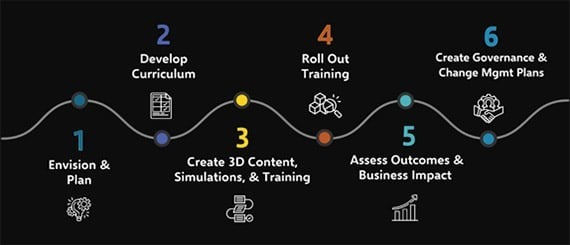
Custom immersive training traditionally involved:
- 3D modeling of environments
- Manual scripting of scenarios
- Programming branching logic
- External development partners
- Lengthy review cycles
For energy enterprises operating across multiple sites, assets, and roles, this model presented three major problems.
First, it was expensive.
Second, it was slow.
Third, it was difficult to update once deployed.
In an industry where procedures evolve with regulatory updates and infrastructure modernization, static custom modules quickly became outdated.
This is the friction AI is beginning to remove.
How AI Reduces Creation Complexity
AI does not eliminate the need for immersive platforms—it streamlines how content is created inside them.
Instead of starting with a blank canvas, AI can assist by:
- Converting standard operating procedures into structured training flows
- Auto-generating scenario branches based on decision points
- Suggesting interactive hotspots within 360° environments
- Drafting assessment questions aligned to learning objectives
- Identifying logical feedback prompts
This significantly reduces manual scripting effort.
For energy teams managing lockout/tagout protocols, confined space procedures, or substation walkthroughs, AI shortens development cycles from months to weeks—or even days.
Lowering the Cost of Customization
Energy training is rarely generic. Site-specific hazards, asset configurations, and operational workflows vary widely.
Historically, customization required bespoke development for every location.
AI changes the economics by enabling:
- Template-based simulation scaffolding
- Rapid environment duplication and modification
- Automated content localization
- Faster compliance updates
- Streamlined scenario variation
This reduces reliance on expensive external studios and allows internal teams to manage updates directly.
When combined with no-code immersive platforms , AI further democratizes content authoring—empowering subject matter experts rather than developers.
From Static Modules to Living Training Systems
Traditional custom modules were often static. Once built, they remained largely unchanged until a full redevelopment cycle occurred.
AI enables a shift from static modules to living training systems.
This means:
- Continuous iteration of existing simulations
- Automated content adjustments based on regulatory changes
- Dynamic scenario updates
- Performance-based refinements
In energy environments where compliance frameworks evolve and infrastructure modernizes, this flexibility is critical.
Improving Instructional Design Quality
Cost reduction is only part of the equation. Quality matters equally.
The VR/AR Association emphasizes that immersive training must be grounded in clear learning objectives and measurable outcomes .
AI enhances instructional quality by:
- Suggesting SMART learning objectives
- Aligning scenarios with competency frameworks
- Identifying potential cognitive overload
- Recommending adaptive branching
This supports better learning outcomes while reducing design effort.
Enabling Adaptive and Performance-Based Learning
One of the most promising cost-saving implications of AI is adaptive training.
Rather than building separate modules for beginner, intermediate, and advanced learners, AI-powered interactive simulations can dynamically adjust based on user performance.
Adaptive immersive training can:
- Increase difficulty for experienced operators
- Offer remediation for new hires
- Introduce variable emergency scenarios
- Adjust feedback based on decision accuracy
This reduces the need for multiple bespoke training tracks.
Instead of three separate modules, you build one intelligent system.
360° Content Creation Becomes Faster and More Accessible
AI is also reducing environmental capture complexity.
Emerging tools such as Marble demonstrate the ability to generate immersive 360° scenes from standard 2D imagery.
For energy enterprises, this enables:
- Rapid digitization of substations or processing facilities
- Faster deployment of induction modules
- Lower production costs
- Scalable content capture across remote assets
The barrier to immersive environment creation continues to fall.
Strategic Implications for Energy Enterprises
Energy leaders evaluating immersive and interactive training strategies should consider:
- How much are we currently spending on bespoke module development?
- How long does it take us to update a procedure-based module?
- Are we dependent on external vendors for every content change?
- Can our training adapt dynamically to workforce performance?
AI-assisted content creation addresses each of these concerns.
It enables:
- Faster time-to-deployment
- Reduced long-term development costs
- Increased internal ownership
- Greater training flexibility
- Higher instructional quality
For an industry managing both operational risk and workforce transition, that combination is powerful.
FAQ
Why has immersive training traditionally been expensive?
Because custom modules required 3D modeling, scripting, programming, and external development resources.
How does AI reduce immersive training costs?
AI automates scenario scaffolding, branching logic, assessment creation, and environment generation—significantly reducing manual effort.
Does AI eliminate the need for custom training?
No. It makes customization faster and more scalable, while reducing reliance on fully bespoke development.
Can AI improve instructional design quality?
Yes. AI can recommend learning objectives, align simulations to competencies, and optimize scenario complexity .
Is this relevant beyond VR?
Absolutely. AI applies to interactive desktop simulations, 360° environments, and blended immersive platforms—not just headsets.


Comments