TL;DR
- Immersive training isn’t inherently expensive—the traditional delivery model is
- Off-the-shelf content lacks relevance; custom builds are slow and costly
- The shift to internal, no-code content creation makes immersive training scalable and affordable
- Manufacturing, construction, and energy companies are using this approach to improve safety, onboarding, and operational performance
For years, immersive training has been positioned as a high-impact but high-cost solution—something innovative organizations explore in pilots but struggle to scale. Across manufacturing plants, construction sites, and energy operations, the same pattern has played out: initial excitement, promising results, and then hesitation when it comes time to roll out broadly.
The assumption has been consistent. Immersive training works, but it is too expensive to deploy at scale.
That assumption, however, was never entirely accurate. The real constraint was not the technology itself, but the way it was delivered.
Most organizations encountered immersive training through one of two paths. The first was off-the-shelf content—pre-built modules designed to be used across many companies. These offered speed and accessibility, but at the cost of relevance. In industrial environments, where workflows, equipment, and risks are highly specific, generic training quickly reveals its limitations. A simulation that does not reflect the actual environment becomes little more than a visual aid. It may engage learners, but it does not prepare them.
The second path was custom-built content. This approach solved the relevance problem by creating tailored simulations aligned to real operations. But it introduced a different barrier: cost and time. Traditional development required external vendors, long production cycles, and significant upfront investment. Worse, once built, content was difficult to update. In industries where processes evolve and conditions change, training quickly became outdated.
This created a false binary. Organizations were forced to choose between content that was affordable but ineffective, or content that was effective but unsustainable.
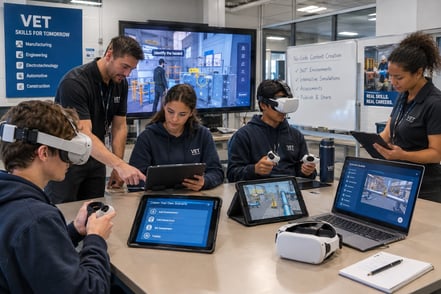
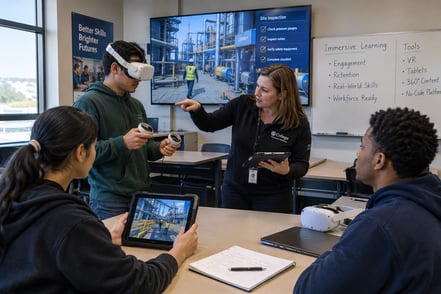
What has changed is not just the maturity of immersive technology, but the emergence of a new model for how training is created. Increasingly, organizations are moving away from buying or outsourcing content and toward building it internally. This shift is being enabled by no-code platforms that allow subject matter experts—the people closest to the work—to create and update training themselves.
This fundamentally changes the economics of immersive training.
Instead of large, infrequent investments in external development, training becomes an ongoing, internal capability. Content can be created quickly, adapted as processes evolve, and deployed across teams without the delays traditionally associated with development cycles. The result is not just lower cost, but greater alignment between training and operations.
This shift is particularly significant in industries where the gap between training and reality has always been most pronounced.
In manufacturing, consistency is everything. Processes are optimized, documented, and refined, yet variability in execution continues to drive defects and inefficiencies. Traditional training methods—SOPs, shadowing, classroom instruction—struggle to ensure that every operator performs tasks the same way, every time. Immersive training, when built internally and aligned to actual workflows, allows operators to practice repeatedly in realistic scenarios, reinforcing standard work in a way static methods cannot.
In construction, the challenge is different but equally complex. No two job sites are the same, and conditions change constantly. Training must account for site-specific risks, evolving environments, and coordination across multiple trades. Off-the-shelf content cannot keep pace with this variability, and custom builds are too slow to adapt to individual projects. Internal creation allows teams to develop training that reflects the realities of each site, improving safety and preparedness without introducing prohibitive costs.
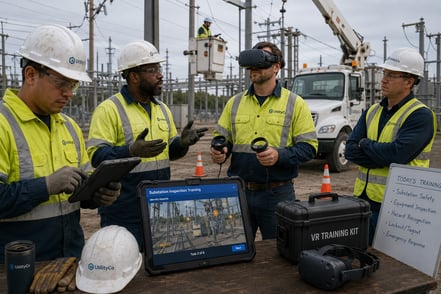
In the energy sector, the stakes are higher still. Workers operate in high-consequence environments where mistakes can lead to serious incidents, operational disruption, or regulatory penalties. Many of the most critical scenarios—emergency response, equipment failures, rare but dangerous events—are difficult or impossible to train for in real life. Immersive simulation provides a safe way to rehearse these scenarios, but only if the training reflects the specific assets, procedures, and risks of the organization. Internal, no-code creation makes this level of specificity achievable at scale, while also allowing content to evolve alongside changing regulations and technologies .
Across all three industries, the pattern is the same. The value of immersive training is not in its novelty, but in its ability to replicate real-world conditions in a scalable way. The barrier has never been whether it works—it has been whether it can be delivered efficiently enough to keep up with operations.
The move toward internal content creation resolves this tension. It transforms immersive training from a one-time investment into a continuous system—one that can adapt, scale, and improve over time. Platforms designed for this approach remove the need for coding or specialized development, allowing organizations to build training as easily as they would create any other operational asset .
The implications are significant. When training becomes easier to create and update, it becomes more relevant. When it is more relevant, it is used more consistently. And when it is used consistently, it begins to impact real performance—reducing incidents, accelerating onboarding, and improving operational efficiency.
This is where the conversation around cost begins to shift. The question is no longer whether immersive training is expensive, but whether traditional training methods are delivering sufficient value. Classroom sessions, static eLearning, and informal on-the-job training all carry hidden costs—lost productivity, inconsistent performance, and avoidable errors. When viewed in this context, immersive training is not an added expense, but a more efficient allocation of resources.
What emerges is a broader transformation in how organizations think about training. It is no longer something that is purchased, delivered, and completed. It is something that is built, refined, and embedded into operations. A system rather than a program.
And systems, when designed correctly, scale.
Immersive training on a budget is not about doing less. It is about doing things differently—moving away from external dependency and toward internal capability. Organizations that embrace this shift are not only reducing costs, but unlocking a level of agility and relevance that traditional models could never provide.
Because the future of training is not defined by the technology used to deliver it, but by the ability to align it with the realities of work—continuously, efficiently, and at scale.
FAQ
Is immersive training still expensive for industrial companies?
It can be if relying on custom development or off-the-shelf content. However, no-code platforms allow organizations to create training internally, significantly reducing costs.
Why doesn’t off-the-shelf immersive training work well?
Because it lacks alignment with site-specific equipment, processes, and risks, making it less effective in real-world applications.
What is no-code immersive training?
It enables non-technical users to create interactive training simulations quickly, without programming or external developers.
Which industries benefit most from this approach?
Manufacturing, construction, and energy benefit significantly due to their need for hands-on, site-specific, and safety-critical training.
What ROI can companies expect from immersive training?
Organizations typically see improved safety, faster onboarding, reduced errors, and lower long-term training costs.



Comments