The energy sector is facing a critical but often underestimated challenge: the loss of experienced workers and the knowledge they carry.
As seasoned employees retire, companies are not just losing people—they are losing decades of operational expertise, safety insight, and institutional memory. This creates growing risks in safety, efficiency, and workforce readiness.
Organizations that fail to capture and transfer this knowledge will face:
- Increased operational and safety risks
- Slower onboarding and reduced productivity
- Loss of consistency across teams and sites
To remain competitive, energy companies must shift from relying on experience held by individuals to scalable, system-driven training approaches that preserve and extend knowledge across the workforce.
The Knowledge Leaving the Industry
The energy industry has always relied heavily on experience.
For decades, critical knowledge has been built on the job—passed down from seasoned workers to newer employees through mentorship, observation, and repetition. It’s practical, situational, and deeply tied to specific environments, equipment, and processes.
But that model is breaking down.
Across oil & gas, utilities, and manufacturing, a significant portion of the workforce is approaching retirement. These are not just employees—they are the people who understand how systems behave under pressure, how to respond when procedures fall short, and how to navigate the complexities that aren’t written in manuals.
When they leave, that knowledge often leaves with them.
Not documented. Not standardized. Not easily replaced.
Why This Is More Than a Talent Problem
It’s easy to frame this as a hiring challenge. But the reality runs deeper.
Replacing headcount is one thing. Replacing experience is another.
New hires may bring technical knowledge, but they lack the contextual understanding that comes from years in the field. They haven’t seen the edge cases. They haven’t built the instincts that drive quick, effective decision-making in high-pressure situations.
This creates a widening gap between what workers know and what they need to know to operate safely and efficiently.
The consequences are significant:
- Increased safety risks as less experienced workers face complex scenarios
- Longer onboarding times as organizations struggle to bring new employees up to speed
- Inconsistent performance across teams and locations
- Greater reliance on a shrinking pool of experts
In an industry where mistakes can have serious operational, financial, and environmental consequences, this is not a minor issue.
It is a growing business risk.
The Limits of Traditional Training
Most organizations recognize the need to transfer knowledge—but the methods often fall short.
Traditional approaches like classroom training, static eLearning, and written documentation are effective for foundational knowledge, but they struggle to capture the nuance of real-world experience.
They can explain what to do.
They rarely prepare people for what actually happens.
Much of the most valuable knowledge in energy is situational:
- How to respond when equipment behaves unexpectedly
- How to identify subtle warning signs before failure
- How to make decisions when conditions change rapidly
This kind of learning is difficult to replicate in static formats. It requires context, interaction, and exposure to realistic scenarios.
Without that, training becomes disconnected from reality—and the gap between knowledge and performance continues to grow.
From Tribal Knowledge to Scalable Systems
To address this challenge, organizations need to rethink how knowledge is captured and shared.
The traditional model—where expertise lives within individuals—is no longer sustainable. Instead, companies must move toward systems that allow knowledge to be:
- Captured from experienced workers
- Structured into usable formats
- Distributed consistently across the workforce
- Updated as conditions evolve
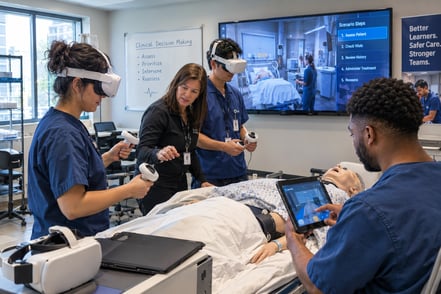
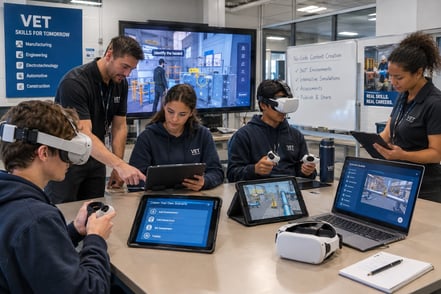
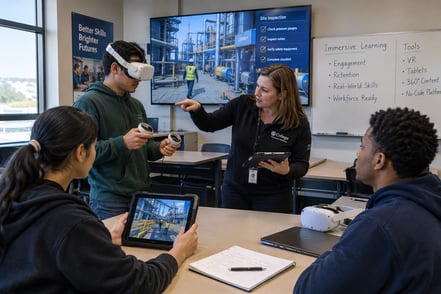
This is where modern approaches like interactive simulation training are beginning to play a critical role.
By recreating real-world environments and scenarios, organizations can:
- Capture the decision-making processes of experienced workers
- Train employees on realistic, high-impact situations
- Standardize knowledge across teams and locations
- Reduce reliance on one-to-one knowledge transfer
Rather than hoping knowledge is passed down, it becomes embedded into the training system itself.
The Cost of Waiting
Many organizations acknowledge this challenge—but delay action.
Whether due to budget constraints, competing priorities, or uncertainty around new technologies, there’s often a tendency to take a “wait and see” approach.
But in this case, waiting carries a cost.
Every retirement represents knowledge that may never be fully recovered. Every delayed initiative widens the gap between experienced and emerging workers.
At the same time, workforce expectations are changing. New employees expect modern, engaging training experiences. They are less likely to invest time and energy in organizations that rely on outdated approaches.
The risk is not just operational—it’s competitive.
The Bottom Line
The energy sector is entering a period of significant workforce transition.
The question is not whether experienced workers will leave.
That is already happening.
The real question is what happens to the knowledge they take with them.
Organizations that act now—capturing, structuring, and scaling that knowledge—will be better positioned to maintain safety, improve performance, and adapt to change.
Those that don’t may find themselves facing a growing gap they can’t easily close.
Your most valuable asset isn’t just your workforce—it’s what they know.
And once that knowledge is gone, it’s much harder to get back.
Key Takeaways
- The energy sector is facing a major loss of experienced workers and institutional knowledge
- This is not just a hiring issue—it’s a growing operational and safety risk
- Traditional training methods struggle to capture real-world, situational knowledge
- Organizations must shift from tribal knowledge to scalable training systems
- Interactive, scenario-based training can help preserve and transfer expertise
- Delaying action increases risk and widens the knowledge gap
- Training strategy is now directly tied to business continuity and competitiveness
FAQ: Workforce Knowledge Loss in Energy
Why is workforce retirement such a big issue in energy?
Because experienced workers hold critical, often undocumented knowledge that is essential for safe and efficient operations. When they leave, that knowledge is difficult to replace.
Can’t companies just hire and train new workers?
Hiring replaces headcount, but not experience. New workers need time and exposure to develop the same level of understanding, which creates a temporary but significant capability gap.
Why isn’t traditional training enough?
Traditional methods often lack the context and realism needed to prepare workers for complex, real-world scenarios—especially in high-risk environments.
How can companies preserve institutional knowledge?
By capturing expertise from experienced workers and embedding it into scalable training systems, such as scenario-based or simulation training.
What happens if companies delay addressing this issue?
They risk increased safety incidents, slower onboarding, inconsistent performance, and loss of competitive advantage as the knowledge gap continues to grow.



Comments