TL;DR
- Traditional construction training builds awareness—but not real job site readiness
- Toolbox talks and classroom sessions don’t prepare workers for:
- Dynamic environments
- Multi-trade coordination
- Real-time decision-making
- The gap is between knowing safety protocols and executing them under pressure
- Immersive training helps workers:
- Practice real scenarios
- Improve coordination and hazard recognition
- Perform more consistently on-site
- Result: improved safety, fewer delays, and better project outcomes
For decades, construction training has followed a familiar model. Workers attend onboarding sessions, participate in toolbox talks, and learn procedures through a combination of instruction and observation. These methods have become deeply embedded in how the industry approaches safety and workforce development.
They are not without value. Toolbox talks, in particular, play an important role in reinforcing awareness and creating a shared language around risk. They help teams align at the start of the day and ensure that critical hazards are not overlooked.
But as construction environments have evolved, a disconnect has emerged between how workers are trained and how work is actually performed.
Modern job sites are more complex than ever. Projects move faster, involve more specialized trades, and require tighter coordination across teams. Conditions shift constantly as structures take shape, equipment moves, and schedules change. Workers are expected to adapt in real time, often making decisions in environments that are noisy, unpredictable, and high-pressure.
In this context, awareness is no longer enough.
The ability to recall a safety protocol or identify a hazard in isolation does not guarantee that a worker will act correctly when faced with a real situation. Execution depends on judgment, timing, and coordination—factors that traditional training methods are not designed to develop.
This is where the concept of “readiness” becomes critical.
A trained worker is someone who understands procedures. A ready worker is someone who can apply those procedures effectively, even when conditions are not ideal. The gap between the two is where most incidents, delays, and inefficiencies occur.
Toolbox talks illustrate this gap clearly. They are efficient, scalable, and easy to deliver, but they are inherently passive. Workers listen, acknowledge, and return to their tasks. There is little opportunity to practice decision-making, test understanding in context, or experience how risks evolve on an active job site.
Similarly, classroom training provides structure and depth, but it lacks realism. It cannot replicate the interplay between multiple trades, the impact of time pressure, or the subtle ways hazards emerge as work progresses. Even on-the-job training, while more practical, varies widely depending on who is delivering it and what conditions happen to be present at the time.
As a result, readiness is left to chance.
Workers accumulate experience over time, learning through exposure rather than structured preparation. While this eventually builds capability, it also introduces risk—particularly for newer workers or those transitioning into unfamiliar roles. In an industry where the margin for error is small, relying on experience alone is neither efficient nor safe.
The consequences of this gap extend beyond safety.
When workers are not fully prepared, execution becomes inconsistent. Tasks take longer, coordination breaks down, and mistakes lead to rework. Small inefficiencies accumulate, affecting project timelines and profitability. In this sense, training is not just a safety function—it is a core driver of operational performance.
To address this, construction companies must move beyond training models that focus solely on awareness and toward approaches that build real-world capability.
Immersive, simulation-based training represents a significant step in this direction.
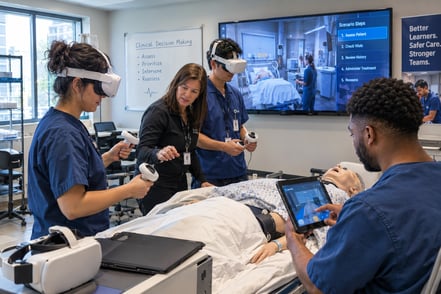
By placing workers in realistic, interactive scenarios, immersive training allows them to experience the kinds of situations they will encounter on the job site—before they face them in reality. Instead of being told what to do, they must actively identify hazards, make decisions, and execute tasks within a simulated environment that reflects the complexity of actual work.
This shift from passive learning to active participation changes how skills are developed.
Workers gain exposure to:
- Dynamic site conditions that evolve over time
- Interactions between multiple trades and workflows
- Time-sensitive decision-making
- Non-obvious or emerging hazards
Through repeated practice, they develop not just knowledge, but judgment. They learn how to respond when plans change, when coordination is required, and when risks are not immediately clear.
Importantly, this approach also improves consistency.
Traditional training often leads to variability in how tasks are performed, particularly across different teams or job sites. Immersive training standardizes the experience, ensuring that all workers are exposed to the same scenarios and expectations. This reduces differences in interpretation and helps align execution across the workforce.
Historically, the challenge with immersive training in construction has been scalability. Custom-built simulations were expensive and time-consuming, while off-the-shelf solutions rarely reflected the unique conditions of specific projects.
That constraint is now changing.
With no-code platforms, construction teams can create their own immersive training content—aligned to their actual sites, workflows, and risks—without relying on external developers. Subject matter experts can build scenarios quickly, update them as projects evolve, and deploy them across teams with minimal friction .
This transforms immersive training from a specialized tool into a practical, everyday capability.
It also changes how organizations think about training more broadly. Instead of a series of events delivered at fixed intervals, training becomes a continuous system—one that evolves alongside the project and supports workers throughout the lifecycle of their work.
The impact is measurable. When workers are better prepared, organizations see:
- Fewer safety incidents and near misses
- Improved coordination across trades
- Reduced rework and project delays
- Greater confidence and performance from the workforce
These outcomes translate directly into both safety improvements and stronger project economics .
The construction industry has long relied on methods that prioritize awareness. While these methods remain valuable, they are no longer sufficient on their own. As projects become more complex and expectations continue to rise, the need for training that builds real readiness will only increase.
Moving from toolbox talks to true readiness is not about replacing existing practices, but about enhancing them with approaches that reflect the realities of modern work.
Because in construction, success is not defined by what workers are told.
It is defined by how they perform when the job site puts that knowledge to the test.
FAQ
What is the difference between training and readiness in construction?
Training focuses on knowledge and awareness, while readiness refers to the ability to apply that knowledge effectively in real job site conditions.
Why aren’t toolbox talks enough?
Toolbox talks are useful for awareness but do not provide hands-on practice or simulate real-world decision-making under pressure.
How does immersive training improve job site performance?
It allows workers to practice realistic scenarios, improving hazard recognition, coordination, and execution in dynamic environments.
Can immersive training be customized for specific projects?
Yes. No-code platforms allow construction teams to create site-specific training aligned to their actual workflows and risks.
What ROI can construction companies expect from immersive training?
Companies typically see fewer incidents, reduced delays, improved coordination, and lower long-term training costs.




Comments