TL;DR
- Lean fails due to inconsistent execution—not flawed strategy
- Traditional training doesn’t build real-world capability
- Simulation-based training systems enable consistent, repeatable performance
- Result: less waste, fewer defects, and scalable continuous improvement
Lean manufacturing has never been more widely adopted—or more inconsistently executed. Across industries, organizations invest heavily in Kaizen initiatives, Six Sigma programs, and standardized workflows, yet many struggle to sustain results beyond initial gains. The issue is rarely the methodology itself. Lean principles are well established, rigorously tested, and widely understood. The breakdown occurs at a more fundamental level: execution on the manufacturing floor.
At its core, lean assumes that work will be performed consistently according to defined standards. However, real manufacturing environments are far more dynamic than process maps suggest. Operators vary in experience, production conditions shift throughout the day, and informal workarounds often emerge under pressure to meet output targets. Over time, even small deviations from standard work accumulate, creating inefficiencies that erode the gains lean initiatives are designed to deliver.
This disconnect between designed processes and actual operations is where most lean efforts stall. It is not that the processes are incorrect—it is that they are not executed consistently enough to produce reliable outcomes. And this inconsistency is not a workforce problem as much as it is a training problem.
Traditional training methods were never designed to support the level of precision and repeatability that lean requires. Most organizations rely on a familiar mix of classroom instruction, SOP walkthroughs, and on-the-job shadowing. These approaches are effective for transferring knowledge, but lean success depends on far more than understanding. It depends on the ability to execute correctly, every time, under real production conditions.
Consider how lean is typically taught. Workers learn about waste reduction, process flow, and quality standards in controlled environments. They are shown the “right way” to perform a task, often under ideal conditions. What they are rarely trained for is what happens when those conditions change—when a machine behaves unpredictably, when materials vary, or when time pressure increases. In these moments, workers must make decisions quickly, often defaulting to habits rather than documented standards.
This is where lean quietly breaks down. Without reinforcement under realistic conditions, standard work becomes theoretical. Operators begin to adapt processes informally, introducing variability that leads to defects, rework, and inefficiencies. Over time, these small inconsistencies compound, and what was once a tightly optimized process begins to drift.
The challenge is compounded by the nature of modern manufacturing operations. Multiple shifts, varying levels of experience, and distributed facilities make it difficult to maintain alignment. Even when processes are well documented, they are not always interpreted or executed the same way. What emerges is a fragmented operational reality, where lean exists in documentation but not consistently in practice.
To address this, manufacturers must rethink the role of training—not as a one-time event, but as a continuous system that supports operational performance. Lean is not sustained through documentation alone; it is sustained through behavior. That behavior must be reinforced, practiced, and continuously aligned with evolving processes.
A modern training system designed for lean execution should do more than explain processes. It should enable workers to:
- Practice standard work repeatedly until it becomes instinctive
- Experience process deviations and learn how to respond without introducing waste
- Apply decision-making under real production conditions
- Align consistently across shifts, teams, and facilities
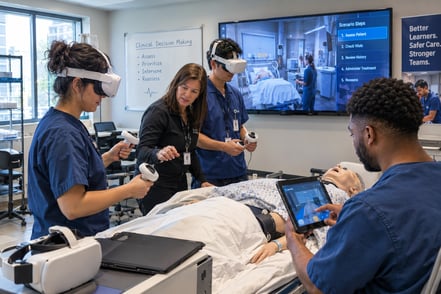
This is where simulation-based training systems are transforming how manufacturers operationalize lean. Instead of relying solely on passive instruction, simulation introduces an active layer of learning—one that mirrors the complexity of the production environment.
Through interactive scenarios, workers can engage with processes in a way that reflects reality. They are not just told what to do; they are required to do it, make decisions, and see the outcomes of those decisions. This builds something traditional training cannot: muscle memory and situational awareness.
The impact of this shift is significant. When workers repeatedly practice standard work in realistic conditions, execution becomes more consistent. Variability decreases. Quality improves. Waste is reduced—not because processes have changed, but because they are finally being performed as intended.
Equally important is the ability to evolve training alongside operations. Lean is built on continuous improvement, yet many training programs remain static. Simulation-based systems, particularly those built on no-code platforms, allow subject matter experts to quickly update and refine training as processes change . This creates a feedback loop where improvements are not only implemented but reinforced across the organization.
In an environment where efficiency, quality, and scalability are constant priorities, this alignment between training and operations becomes a critical advantage. Manufacturers that integrate training systems into their lean strategy are better positioned to sustain improvements, reduce process variability, and scale best practices across their operations .
Ultimately, lean manufacturing does not fail because of flawed principles. It fails because of inconsistent execution. And execution cannot be standardized through documentation alone—it must be built through experience.
The path from good to world-class manufacturing is not defined by better processes, but by better execution of those processes. Organizations that recognize this—and invest in training systems that reflect the realities of the factory floor—are the ones that turn lean from a philosophy into a sustained operational advantage.
FAQ
Why do lean manufacturing initiatives fail?
Lean initiatives typically fail due to inconsistent execution on the manufacturing floor, not because of flawed strategies or frameworks.
How does training impact lean success?
Training determines whether workers can consistently apply standard processes. Without effective training, variability increases and lean benefits diminish.
What is simulation-based training in manufacturing?
It is an interactive approach where workers practice real production scenarios, improving execution, decision-making, and consistency.
How does simulation training support lean principles?
It reinforces standard work, reduces variability, and helps workers respond effectively to process deviations—core elements of lean manufacturing.
What ROI can manufacturers expect from improved training systems?
Manufacturers typically see reduced waste, fewer defects, improved efficiency, and better scalability of lean initiatives.





Comments