Why the Organizations Winning the Future Will Be the Ones That Prepare People — Not Just Processes — for Complexity
TL;DR
Across energy, manufacturing, aviation, healthcare, construction, and other high-consequence industries, organizations are increasingly recognizing that operational performance is deeply tied to human performance.
Human performance optimization (HPO) is emerging as a strategic workforce initiative focused on improving how employees think, respond, communicate, and execute inside real operational environments.
Traditional workforce training models often focus heavily on knowledge transfer and compliance completion. But modern operational environments demand more than theoretical understanding. They require situational awareness, procedural confidence, adaptability, and decision-making under pressure.
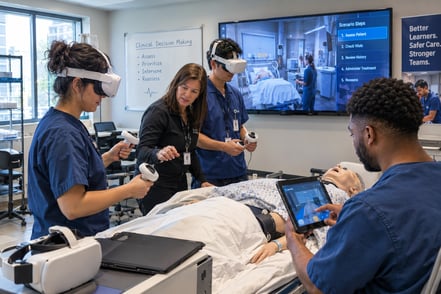
Immersive learning and interactive simulation training are becoming powerful tools for human performance optimization because they allow employees to rehearse operational complexity before facing it in the real world.
The organizations investing in experiential workforce development today are building safer, more resilient, and more operationally prepared workforces for the future.
Operational Excellence Is Increasingly a Human Performance Challenge
For years, organizations approached operational improvement primarily through systems, processes, and technology.
Industrial sectors invested heavily in:
- Automation
- Standardization
- Digital transformation
- Predictive analytics
- Equipment modernization
- Process optimization
Those investments dramatically improved operational capability.
But as industries continue evolving, many organizations are confronting a realization that is both simple and profound:
Even highly optimized systems still depend on human performance.
People remain responsible for:
- Decision-making
- Communication
- Procedural execution
- Hazard recognition
- Crisis response
- Operational adaptability
- Situational judgment
In many industries, the margin for error is becoming smaller at the exact moment operational complexity is increasing.
Energy organizations are balancing grid modernization, renewable integration, and aging infrastructure simultaneously. Manufacturers are navigating automation alongside workforce turnover. Healthcare providers operate inside environments where cognitive overload and procedural precision coexist daily. Aviation organizations continue functioning in systems where consistency and human reliability are non-negotiable.
In each case, operational outcomes increasingly depend not simply on what systems are designed to do, but on how effectively people perform inside those systems.
This is why human performance optimization is becoming one of the most important strategic conversations happening across industrial workforce development.
The Limits of Traditional Training Models
One of the biggest misconceptions in workforce development is the belief that knowledge transfer automatically produces operational readiness.
Historically, many training systems were designed around content delivery:
- Classroom instruction
- SOP reviews
- Compliance modules
- eLearning courses
- Certification programs
These approaches are valuable for communicating information, but operational performance depends on much more than information retention.
Employees rarely fail because they never encountered the procedure intellectually.
More often, failures emerge because operational environments introduce:
- Stress
- Distraction
- Cognitive overload
- Environmental complexity
- Time pressure
- Fatigue
- Communication breakdowns
- Situational ambiguity
An employee may fully understand a procedure conceptually while still struggling to execute it effectively inside a live environment.
This is where traditional workforce training often breaks down.
Passive learning can teach employees what should happen.
It is far less effective at preparing them for how situations unfold operationally.
Human performance is inherently behavioral and contextual.
People improve performance through repetition, exposure, familiarity, and experiential learning—not simply through information consumption.
Why Experiential Learning Improves Human Performance
The most effective operational learning has always happened through experience.
Pilots train in flight simulators before entering live aircraft. Medical professionals rehearse procedures before treating patients. Military teams train repeatedly under realistic conditions before deployment.
These professions understand something industrial organizations are increasingly recognizing:
Performance improves when people rehearse complexity before encountering real-world consequences.
Immersive learning and interactive simulation training allow organizations to create those rehearsal environments at scale.
Employees can safely practice:
- Emergency response procedures
- Hazard recognition
- Operational workflows
- Communication protocols
- Equipment interactions
- Decision-making under pressure
- Maintenance procedures
- Safety-critical scenarios
Instead of separating learning from operational reality, immersive simulations embed employees directly inside contextualized environments that mirror real-world conditions.
This changes workforce development fundamentally.
Employees do not simply memorize procedures.
They begin to develop:
- Situational familiarity
- Procedural confidence
- Environmental awareness
- Cognitive preparedness
- Behavioral consistency
Over time, repeated experiential learning strengthens operational readiness in ways traditional instruction alone rarely achieves.
Human Performance Optimization Is About More Than Safety
Many organizations initially approach human performance optimization through the lens of safety and incident reduction.
And safety is certainly a major driver.
But human performance optimization has much broader operational implications.
Organizations increasingly recognize that workforce performance impacts:
- Operational reliability
- Maintenance quality
- Downtime reduction
- Team coordination
- Workforce adaptability
- Change management
- Communication effectiveness
- Knowledge retention
- Employee confidence
- Organizational resilience
In many ways, HPO represents a broader evolution in how organizations think about workforce capability itself.
Historically, organizations often treated workforce development as a support function.
Today, workforce capability is becoming a core operational asset.
The organizations adapting most effectively to operational complexity are often the ones investing most intentionally in how people prepare for complexity—not simply how systems are engineered.
The Rise of Simulation-Based Workforce Rehearsal
One of the most important shifts happening right now is the movement away from static training toward continuous operational rehearsal.
Modern operational environments evolve constantly:
- Procedures change
- Technologies evolve
- Equipment upgrades occur
- Regulations shift
- Workforce compositions change
- Operational risks emerge
As a result, workforce readiness cannot remain static either.
Interactive simulation training allows organizations to continuously evolve workforce preparation alongside operational reality.
This is especially important in environments where:
- Live training is dangerous
- Equipment downtime is costly
- Operational disruptions are difficult
- Real-world practice opportunities are limited
Simulation-based learning creates scalable rehearsal systems that allow organizations to operationalize experience itself.
A technician can repeatedly rehearse lockout/tagout procedures before entering a live electrical environment. A healthcare team can practice emergency response protocols without patient risk. Manufacturing operators can rehearse troubleshooting workflows before production disruptions occur.
In each case, the organization is not simply distributing knowledge.
It is conditioning workforce performance before operational consequences emerge.
That distinction may ultimately define the future of workforce development.
Human Performance Optimization Is Becoming Foundational Workforce Infrastructure
There was a time when immersive learning and simulation-based workforce development were viewed primarily as innovation initiatives.
That perception is changing quickly.
Today, organizations are increasingly adopting immersive workforce training because traditional workforce development systems are struggling to keep pace with operational reality.
The business drivers are becoming difficult to ignore:
- Faster onboarding
- Improved safety preparedness
- Better workforce confidence
- Reduced operational risk
- Improved procedural consistency
- Faster adaptation to change
- Improved retention of institutional knowledge
- Greater workforce resilience
Most importantly, immersive experiential learning aligns closely with the future direction of industrial work itself: environments where adaptability, operational awareness, and continuous learning are essential capabilities.
The organizations investing in human performance optimization today are not simply improving training.
They are building operationally resilient workforces designed for complexity.
Final Thoughts
Human performance optimization is rapidly becoming one of the defining operational priorities of modern industrial organizations.
The shift is not simply technological.
It is philosophical.
Organizations are beginning to recognize that operational excellence is not determined solely by systems, equipment, or procedures. It is also determined by how effectively people perform inside increasingly dynamic operational environments.
Immersive learning and simulation-based workforce development are powerful because they acknowledge a simple truth:
People become operationally prepared through realistic experience.
The organizations building scalable experiential learning systems today will be better positioned to navigate workforce disruption, operational complexity, and technological change tomorrow.
Because ultimately, the future of operational excellence will depend not only on how organizations optimize systems—
—but how effectively they optimize human performance inside them.
FAQ
What is human performance optimization?
Human performance optimization (HPO) focuses on improving workforce capability, situational awareness, procedural execution, decision-making, and operational readiness in real-world environments.
Why is human performance important in industrial environments?
Human performance directly impacts safety outcomes, operational reliability, procedural consistency, communication effectiveness, and workforce adaptability.
How does immersive learning improve human performance?
Immersive learning allows employees to rehearse realistic operational scenarios through experiential training environments that improve confidence, situational awareness, and procedural familiarity.
What is simulation-based workforce training?
Simulation-based training places employees inside realistic operational scenarios where they actively practice procedures, workflows, communication, and decision-making.
What industries use human performance optimization training?
Industries including energy, manufacturing, aviation, healthcare, construction, and education use immersive workforce development and simulation-based training to improve workforce readiness and operational performance.
Why are organizations moving beyond traditional workforce training?
Traditional workforce training is often passive and disconnected from operational reality. Immersive experiential learning improves preparedness by allowing employees to rehearse real-world complexity safely.
Can immersive workforce training integrate with enterprise LMS platforms?
Yes. Many immersive learning platforms support SCORM and xAPI integration with enterprise LMS and workforce analytics systems.
What are the business benefits of human performance optimization?
Organizations improve workforce readiness, operational reliability, safety preparedness, procedural consistency, workforce confidence, and organizational resilience through human performance optimization initiatives.





Comments