Why the Future of Operational Performance Depends on How Quickly Organizations Can Prepare People for Complexity
TL;DR
Across energy, manufacturing, aviation, healthcare, construction, and education, organizations are facing a growing workforce readiness crisis. Labor shortages, retiring expertise, operational complexity, and rising safety expectations are exposing the limitations of traditional workforce training models.
Workforce readiness is no longer simply about completing training modules or passing compliance assessments. It is about preparing employees to perform safely, confidently, and effectively inside real operational environments.
Organizations are increasingly turning toward immersive learning and interactive simulation training to accelerate workforce readiness through experiential learning. Rather than relying solely on passive instruction, immersive training platforms allow employees to rehearse real-world procedures, build situational awareness, and develop operational confidence before entering live environments.
As industries continue evolving, workforce readiness is becoming less of an HR initiative and more of an operational imperative.
The Workforce Readiness Challenge Is Bigger Than a Labor Shortage
Much of the conversation around the modern workforce has focused on hiring challenges.
And those challenges are certainly real.
Across industrial sectors, organizations are struggling to recruit enough skilled workers to replace retiring personnel while simultaneously adapting to increasingly complex technologies and operational systems.
But beneath the labor shortage conversation lies a deeper issue that many organizations are only beginning to fully recognize:
The challenge is not simply finding workers.
The challenge is preparing workers for operational reality fast enough.
This distinction matters because modern operational environments are becoming exponentially more demanding. Employees are expected to navigate increasingly technical systems while maintaining procedural precision, safety compliance, and operational efficiency under constant pressure.
At the same time, organizations are onboarding employees more quickly than ever before, often with less opportunity for prolonged field mentorship or experiential learning.
Historically, workforce readiness developed gradually through exposure, repetition, and direct operational experience. New employees learned alongside experienced personnel over extended periods of time, slowly building the situational awareness and procedural familiarity necessary for operational competence.
That model is becoming increasingly difficult to sustain.
An entire generation of experienced workers is retiring, and with them goes decades of institutional knowledge that has historically been transferred informally through hands-on operational exposure.
Organizations are now confronting a difficult question:
How do you accelerate workforce readiness in environments where operational complexity continues to increase while opportunities for slow experiential learning continue to shrink?
This is the workforce development problem immersive learning is uniquely positioned to solve.
Why Training Completion Does Not Equal Workforce Readiness
One of the most important shifts happening in industrial workforce development is the growing recognition that training completion is not the same thing as operational preparedness.
For decades, workforce training systems have largely been built around measurable completion metrics:
- Did the employee complete onboarding?
- Did they pass the assessment?
- Did they review the SOPs?
- Did they finish the compliance modules?
Those metrics are useful, but they do not necessarily answer the most important operational question:
Can the employee perform effectively inside a real-world environment?
Operational readiness depends on much more than theoretical understanding.
It requires:
- Situational awareness
- Procedural familiarity
- Decision-making under pressure
- Hazard recognition
- Environmental confidence
- Behavioral repetition
- Human performance consistency
An employee may understand a procedure conceptually while still lacking the confidence or operational familiarity to execute it effectively in the field.
This is especially true in industries where environments are dynamic, high-risk, and procedurally complex.
Reading about an emergency shutdown procedure is not the same as navigating one under pressure. Watching a safety video cannot replicate the cognitive demands of operating inside a hazardous environment. Completing digital coursework rarely reproduces the stress, distraction, timing, and environmental variables that shape real operational performance.
Workforce readiness is ultimately behavioral.
And behavior is developed through experience.
Experiential Learning Is Becoming Essential for Workforce Development
The most effective workforce learning has always occurred through practice.
Pilots train in simulators before flying aircraft. Medical professionals rehearse procedures before entering surgical environments. Elite athletes train under game-like conditions before competition.
Industrial workforce development is increasingly moving in the same direction.
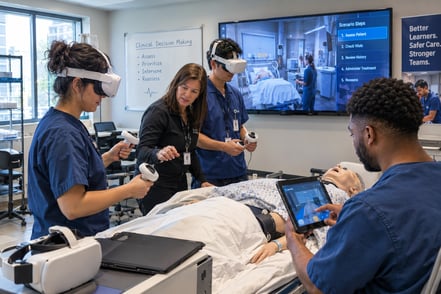
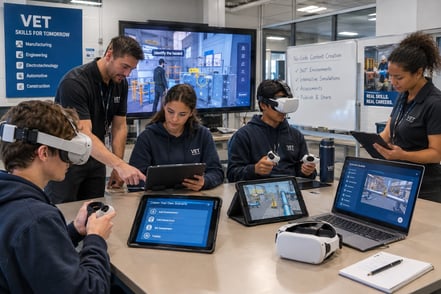
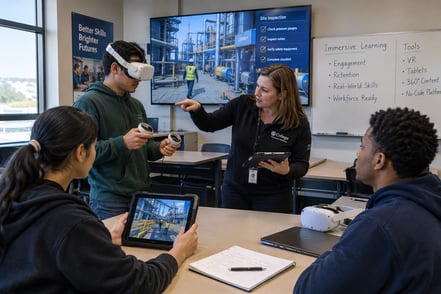
Immersive learning and interactive simulation training allow organizations to create realistic operational rehearsal environments where employees can safely practice procedures, workflows, and decision-making before entering live operational conditions.
This changes workforce development fundamentally.
Instead of separating learning from operational reality, experiential training embeds employees directly inside contextualized learning environments that mirror the conditions where work actually occurs.
Employees are no longer simply consuming information.
They are actively participating in:
- Operational workflows
- Safety procedures
- Equipment interactions
- Emergency response scenarios
- Hazard identification exercises
- Maintenance tasks
- Situational decision-making
Over time, repeated exposure builds procedural confidence and operational familiarity in ways that passive learning alone cannot replicate.
The result is not simply better knowledge retention.
It is improved workforce preparedness.
Why Workforce Readiness Has Become an Operational Imperative
In many industrial sectors, operational complexity is increasing faster than workforce capability pipelines can adapt.
Energy organizations are managing aging infrastructure alongside renewable integration and grid modernization. Manufacturers are navigating automation, robotics, and interconnected production systems. Healthcare providers face procedural complexity under growing staffing pressures. Aviation organizations continue operating in environments where precision and consistency are non-negotiable.
As operational systems become more sophisticated, the margin for workforce error becomes smaller.
Organizations can no longer afford workforce development models that rely heavily on passive learning and slow field exposure alone.
This is one reason immersive workforce readiness programs are gaining momentum so quickly.
Simulation-based learning allows organizations to create scalable operational rehearsal environments without:
- Introducing real-world risk
- Disrupting production
- Creating equipment downtime
- Limiting training frequency
- Depending exclusively on experienced mentors
A technician can practice lockout/tagout procedures repeatedly before entering a live electrical environment. A manufacturing operator can rehearse troubleshooting workflows before stepping onto a production floor. A healthcare worker can simulate emergency procedures repeatedly without patient risk.
In each case, the organization is not simply delivering training content.
It is developing operational confidence before operational consequences occur.
Workforce Readiness Is Becoming Continuous Rather Than Linear
Another major shift happening across workforce development is the realization that readiness is not a one-time event.
Historically, organizations often treated training as a linear progression:
- Onboarding
- Certification
- Field exposure
- Periodic refreshers
But modern industries evolve too quickly for workforce learning to remain static.
Procedures change. Technologies evolve. Equipment upgrades occur. Safety protocols adapt. Operational environments continuously shift.
As a result, workforce readiness increasingly requires continuous experiential learning rather than isolated training events.
Immersive learning platforms are especially powerful because they allow organizations to update, scale, and repeat workforce rehearsal continuously as operations evolve.
This transforms workforce development from a compliance activity into an adaptive operational capability.
The organizations building these systems today are creating workforces that are not only trained—but operationally resilient.
Final Thoughts
The future of workforce development will not be defined by how efficiently organizations distribute information.
It will be defined by how effectively they prepare employees to perform inside increasingly complex operational environments.
That distinction is reshaping how organizations think about training, onboarding, safety, and operational readiness itself.
Workforce readiness is no longer simply an HR function or learning initiative.
It is becoming one of the most important determinants of operational performance, workforce resilience, and long-term organizational adaptability.
Immersive learning and interactive simulation training are powerful because they acknowledge a simple truth:
People become operationally prepared through experience.
The organizations that build scalable systems for experiential workforce development today will be better positioned to navigate the operational complexity of tomorrow.
FAQ
What is workforce readiness?
Workforce readiness refers to an employee’s ability to safely, confidently, and effectively perform real-world operational tasks and responsibilities.
Why is workforce readiness becoming more important?
Organizations are facing increasing operational complexity, workforce turnover, safety requirements, and onboarding pressures. Workforce readiness helps employees become operationally effective faster and more safely.
How does immersive learning improve workforce readiness?
Immersive learning allows employees to practice realistic procedures, workflows, and operational scenarios through experiential training environments that improve confidence, retention, and situational awareness.
What industries use immersive workforce readiness training?
Industries including energy, manufacturing, aviation, healthcare, construction, and education use immersive workforce readiness programs for onboarding, safety preparedness, operational training, and workforce development.
What is interactive simulation training?
Interactive simulation training places employees inside realistic digital operational environments where they actively rehearse procedures, workflows, and decision-making scenarios.
Why are organizations moving beyond traditional eLearning?
Traditional eLearning is often passive and disconnected from operational reality. Immersive experiential learning creates stronger workforce preparedness through realistic practice and repetition.
Can workforce readiness training integrate with enterprise LMS platforms?
Yes. Many immersive learning platforms support LMS integrations through SCORM and xAPI compatibility.
What are the business benefits of immersive workforce readiness programs?
Organizations use immersive workforce development to accelerate onboarding, improve safety preparedness, reduce operational risk, improve workforce confidence, standardize procedures, and retain institutional knowledge.



Comments