TL;DR
- Precision manufacturing failures are rarely due to lack of knowledge—but inconsistent execution at fine tolerances
- Small errors can lead to:
- Product defects
- Rework and scrap
- Compliance failures
- Traditional training doesn’t build repeatable precision under real conditions
- Simulation-based training systems help manufacturers:
- Improve accuracy and consistency
- Reduce defects and rework
- Scale quality across teams and sites
In precision manufacturing environments, the margin for error is almost nonexistent. Whether assembling aerospace components, calibrating medical devices, or producing semiconductor equipment, even the smallest deviation can have outsized consequences. A torque slightly out of range, a misaligned component, or a minor contamination event can compromise product integrity, trigger costly rework, or lead to regulatory non-compliance.
And yet, despite rigorous training programs and strict quality controls, defects still occur.
This is not because workers lack knowledge. In most cases, operators are highly trained, procedures are well documented, and quality standards are clearly defined. The challenge lies elsewhere—in the ability to execute consistently at the required level of precision, every time.
Precision manufacturing is not simply about following steps. It is about performing those steps with exactness under real-world conditions. This includes managing fine motor skills, interpreting subtle feedback from tools and materials, and maintaining focus over repetitive tasks. It also requires adapting to small variations in components, equipment behavior, or environmental conditions—all without compromising accuracy.
Traditional training methods are not designed to build this level of capability.
Most organizations rely on a combination of classroom instruction, SOP documentation, and supervised on-the-job training. These approaches are effective for explaining processes and demonstrating techniques, but they fall short in developing repeatable precision. Workers may understand the correct procedure and even perform it successfully in controlled conditions, yet still struggle to maintain consistency over time or across varying situations.
The gap becomes particularly visible at scale. As production increases and more operators are brought into the process, variability grows. Small differences in technique, interpretation, or attention to detail begin to accumulate. Over time, this variability manifests as defects, rework, and inefficiencies that are difficult to trace back to a single cause.
This is the central challenge of precision manufacturing: how to ensure that every operator performs with the same level of accuracy, regardless of experience, shift, or location.
At the heart of this challenge is training—not in terms of quantity, but in terms of design.
Traditional training is built around knowledge transfer and initial skill acquisition. Precision manufacturing, however, requires something more: continuous reinforcement of exact execution. Workers must not only learn the correct method, but internalize it to the point where it becomes instinctive, even under pressure or fatigue.
This is where simulation-based training systems are reshaping how manufacturers approach precision.
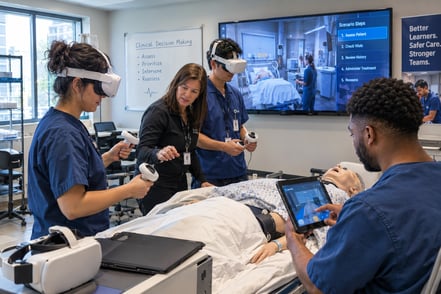
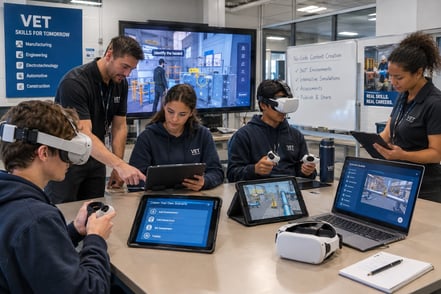
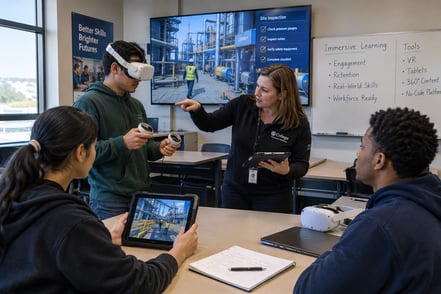
By introducing interactive, scenario-based environments, simulation allows workers to practice tasks repeatedly in conditions that mirror real production. Instead of observing or performing a task once under supervision, operators can engage in structured repetition, receiving feedback and refining their technique over time.
This repetition is critical. Precision is not developed through explanation—it is developed through practice.
Simulation also enables training for variability, which is often overlooked in traditional programs. Workers can be exposed to subtle differences in materials, tool responses, or environmental factors, learning how to maintain accuracy even when conditions are not ideal. This builds adaptability without sacrificing consistency.
Another key advantage is the ability to standardize training across the organization. In many manufacturing environments, expertise is concentrated among a small group of experienced operators. Knowledge is transferred informally, leading to inconsistencies in how tasks are performed. Simulation-based systems capture best practices and deliver them uniformly, ensuring that all workers are trained to the same standard.
Modern no-code platforms further enhance this capability by allowing subject matter experts to create and update training content directly . As processes evolve or new quality requirements emerge, training can be updated quickly, ensuring alignment between instruction and execution.
The impact of this approach is measurable. When operators are trained through repeated, realistic practice, variability decreases. Fewer errors occur. Quality improves. Rework and scrap are reduced. In industries where precision is directly tied to cost and compliance, these improvements translate into significant operational and financial gains .
For manufacturing leaders, the implication is clear. Achieving zero defects is not solely a function of better processes or stricter controls. It is a function of how consistently those processes are executed by the workforce.
And consistency cannot be achieved through documentation alone. It must be built through training systems that reinforce exact execution at scale.
Precision manufacturing will only become more demanding as technologies advance and tolerances tighten. Organizations that continue to rely on traditional training methods will find it increasingly difficult to maintain quality at scale. Those that adopt training systems designed for real-world performance will be better positioned to meet these challenges.
Because in precision manufacturing, success is not determined by what workers know—it is determined by how precisely they perform, every single time.
FAQ
Why is precision so difficult to maintain in manufacturing?
Because even small variations in technique, materials, or conditions can lead to errors, making consistent execution challenging at scale.
What industries rely on precision manufacturing?
Industries include aerospace, medical devices, semiconductors, automotive, and electronics—where tight tolerances and high quality standards are critical.
Why does traditional training fall short in precision environments?
Traditional training focuses on understanding processes, but does not provide enough repetition or realism to build consistent, high-accuracy execution.
How does simulation-based training improve precision?
It enables repeated practice in realistic scenarios, helping workers build muscle memory, adapt to variability, and maintain accuracy under real conditions.
What ROI can manufacturers expect from improved precision training?
Manufacturers typically see reduced defects, less rework, improved compliance, and increased operational efficiency.



Comments