TL;DR
- Most construction workers are trained—but not prepared for real job site conditions
- Traditional methods (toolbox talks, classroom training) don’t translate to performance under pressure
- Safety incidents are often caused by execution gaps, not knowledge gaps
- Immersive, simulation-based training helps workers:
- Practice real scenarios
- Improve hazard recognition
- Make better decisions under pressure
- Result: fewer incidents, less rework, and improved project performance
Construction is one of the most safety-critical industries in the world. Every year, companies invest significant time and resources into training programs designed to protect workers and ensure compliance. Toolbox talks are delivered, onboarding sessions are completed, and safety protocols are clearly documented.
And yet, incidents still happen.
This creates a difficult but necessary question: if workers are trained, why do failures persist on the job site?
The answer lies in a fundamental gap between training and reality.
Most construction workers are not lacking knowledge. They understand safety procedures, recognize common hazards, and know the rules they are expected to follow. The issue is not what they know—it is how effectively they can apply that knowledge in the moment, under real job site conditions.
Those conditions are rarely predictable.
A construction site is a constantly changing environment. New hazards emerge as projects progress. Teams shift, subcontractors rotate in and out, and schedules introduce pressure to move quickly. Workers must navigate incomplete information, coordinate across trades, and make decisions in real time. In these moments, safety is not about recalling information—it is about executing correctly under pressure.
Traditional training methods are not designed for this.
Toolbox talks, for example, are effective at raising awareness. They highlight risks, reinforce procedures, and create a shared understanding of safety expectations. But they are inherently passive. Workers listen, acknowledge, and move on. There is little opportunity to practice decision-making or experience how hazards unfold in context.
Classroom-based training faces a similar limitation. It can explain procedures in detail, but it cannot replicate the urgency, noise, and complexity of an active job site. Even on-the-job shadowing, while valuable, is inconsistent and dependent on the experience of the individual providing guidance.
The result is a familiar pattern. Workers complete training and demonstrate understanding, but when faced with real situations—tight deadlines, unexpected changes, or competing priorities—execution breaks down. Steps are skipped, hazards are overlooked, and communication falters.
This is not a failure of compliance. It is a failure of preparation.
Many of the most serious incidents in construction occur not because workers were unaware of risks, but because they were unprepared for how those risks would present themselves in dynamic conditions. A hazard that is obvious in a training manual may be far less visible when embedded in a busy, evolving work environment. A procedure that seems straightforward in theory may become difficult to execute when multiple teams are involved and time is limited.
This gap between knowing and doing carries significant consequences.
From a safety perspective, it increases the likelihood of injuries, near misses, and serious incidents. From an operational perspective, it introduces delays, rework, and disruptions that impact project timelines and profitability. Investigations, shutdowns, and corrective actions all carry costs—both direct and indirect—that extend far beyond the initial event.
In this sense, ineffective training is not just a safety issue. It is a performance issue.
To address it, construction companies must move beyond training models that focus solely on information delivery and toward approaches that build real-world capability.
This is where immersive, simulation-based training is beginning to play a critical role.
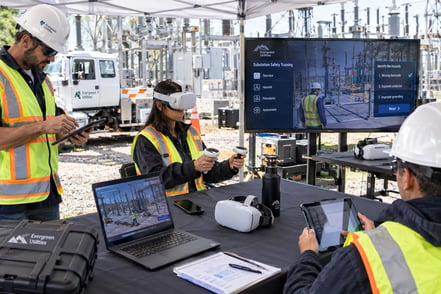
Unlike traditional methods, immersive training allows workers to experience job site scenarios in a controlled environment. Instead of being told what to do, they are placed in situations where they must identify hazards, make decisions, and execute tasks as they would in the field. This transforms training from a passive activity into an active process of skill development.
The value of this approach lies in its realism.
Workers can be exposed to:
- Changing site conditions
- Interactions between multiple trades
- Time pressure and sequencing challenges
- Subtle or emerging hazards
By practicing in these environments, they develop not only knowledge, but judgment. They learn how to respond when conditions are not ideal—when plans change, when risks are not immediately obvious, and when decisions must be made quickly.
This has a direct impact on both safety and operational performance.
When workers are better prepared, they are more likely to:
- Recognize hazards before they escalate
- Follow procedures correctly under pressure
- Coordinate effectively with other teams
- Avoid errors that lead to rework or delays
Over time, this leads to fewer incidents, smoother project execution, and more predictable outcomes.
Historically, the challenge with immersive training has been cost and scalability. Custom-built simulations were expensive and time-consuming to develop, while off-the-shelf content often failed to reflect the realities of specific job sites.
That constraint is now changing.
With the emergence of no-code platforms, construction teams can create their own immersive training content—quickly, affordably, and aligned to their actual projects. Subject matter experts can build scenarios that reflect real site conditions, update them as projects evolve, and deploy them across teams without relying on external developers .
This shift transforms immersive training from a specialized initiative into a practical, scalable system.
It also changes the cost equation. When training can be created and updated internally, organizations reduce dependency on external vendors and gain the flexibility to keep training aligned with real-world conditions. Over time, this leads not only to better outcomes, but to lower overall training costs and improved return on investment .
The broader implication is clear. Construction safety training cannot remain static in an industry that is inherently dynamic. As job sites become more complex and schedules more demanding, the need for training that reflects real conditions will only increase.
Organizations that continue to rely solely on traditional methods will struggle to close the gap between knowledge and execution. Those that adopt more immersive, practice-based approaches will be better positioned to prepare their workforce for the realities of the job site.
Because in construction, safety is not determined by what workers know.
It is determined by what they do—when it matters most.
FAQ
Why does construction safety training fail to prevent incidents?
Because traditional training focuses on knowledge, not real-world application. Workers are not always prepared for dynamic, high-pressure job site conditions.
What are toolbox talks missing?
Toolbox talks raise awareness but do not provide hands-on practice or simulate real decision-making under pressure.
How does immersive training improve construction safety?
It allows workers to practice realistic scenarios, improving hazard recognition, decision-making, and execution in real-world conditions.
Can immersive training be adapted to specific job sites?
Yes. Modern no-code platforms allow companies to create site-specific training that reflects actual conditions, risks, and workflows.
What ROI can construction companies expect from immersive training?
Companies typically see fewer incidents, reduced rework, improved productivity, and lower long-term training costs.





Comments