


As immersive learning matures across the energy sector, a common question emerges: Is 360° image content still valuable without a VR headset?
The short answer is yes.
While head-mounted displays (HMDs) like Meta Quest and HTC Vive deliver maximum immersion, 360° images and videos viewed on desktop or mobile devices still offer a significant leap over traditional 2D training materials. When paired with strong instructional design and interactive elements, 360° content drives higher engagement, better spatial awareness, and improved knowledge retention—without requiring enterprise-wide hardware deployment.
Research from the VR/AR Association (VRARA) shows immersive learning increases knowledge retention and safety outcomes in high-risk industries like energy . Meanwhile, industrial XR survey data confirms that training remains the #1 use case for immersive technologies, with safety and equipment operation leading adoption priorities .
For energy enterprises navigating aging workforces, regulatory pressure, and distributed teams, the real opportunity lies in platforms that allow you to create once and publish everywhere—VR headset and desktop alike.
The Immersion Spectrum: Not All Impact Requires a Headset
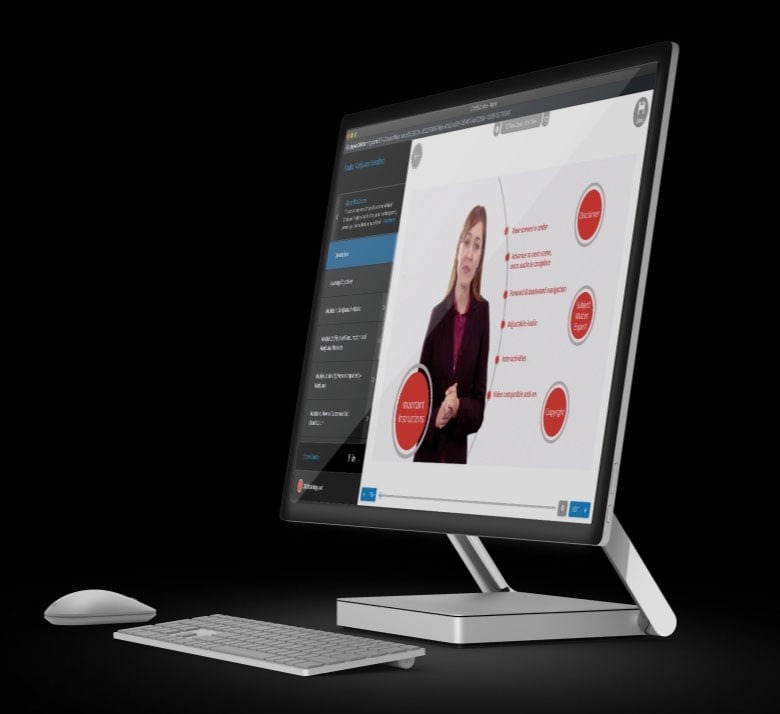
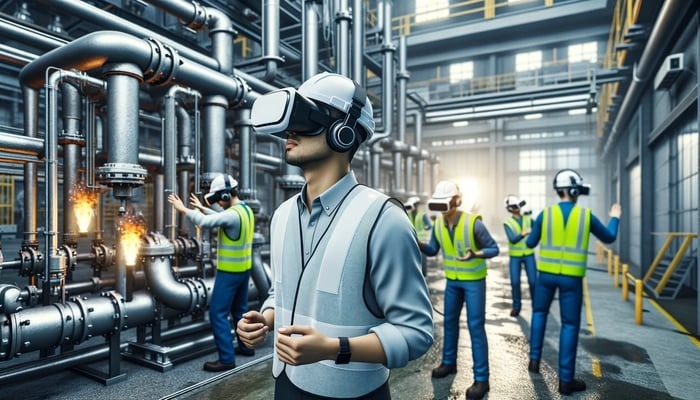
Immersion exists on a spectrum. Fully immersive VR blocks out the physical world, creating a sense of presence inside a simulated environment. Desktop-based 360° experiences, while less immersive, still allow learners to:
- Navigate real environments spatially
- Look around freely instead of consuming static slides
- Engage with hotspots, prompts, and embedded assessments
- Experience situational context
According to the Industrial XR Forum survey, training is the most common objective of XR programs, particularly for safety, hazardous environments, and equipment operation . These applications benefit from spatial awareness—even when delivered on a desktop.
In energy environments where context is everything—substations, refineries, turbine nacelles—360° visuals provide realism that flat diagrams simply cannot replicate.
Yes, you lose a degree of immersion without a headset. But compared to PowerPoint or static eLearning modules, 360° content is dramatically more engaging.
Why 360° Content Still Outperforms Traditional 2D Training
1. Spatial Context Improves Decision-Making
The VR/AR Association Energy White Paper highlights the complexity of systems in oil & gas, utilities, and nuclear environments . Traditional 2D schematics often fail to communicate:
- Equipment relationships
- Hazard proximity
- Environmental constraints
- Workflow sequencing
360° environments allow learners to visually explore operational spaces, reinforcing spatial memory—even without full VR.
2. Engagement Drives Retention
Immersive methodologies have been shown to increase retention and confidence in applying learned skills . Engagement is not solely dependent on a headset; it depends on:
- Interactivity
- Realistic scenario design
- Feedback loops
- Consequence-based learning
If a 360° desktop experience includes hazard identification tasks, procedural walkthroughs, or branching decision points, it activates deeper cognitive processing than passive content ever could.
3. Accessibility Accelerates Adoption
One of the largest barriers to XR deployment in energy is hardware logistics—device management, IT approval, and field distribution .
Desktop-compatible 360° content:
- Eliminates initial hardware friction
- Enables pilot programs without capital expenditure
- Supports remote teams instantly
- Integrates into existing LMS platforms
This blended approach aligns with research showing XR works best as part of a broader learning ecosystem—not as a standalone solution .
The Real Differentiator: Learning Design
Technology does not guarantee impact. Instructional design does.
The VR/AR Association emphasizes that immersive training must be rooted in clear learning objectives and strong instructional frameworks . Poorly designed immersive content can overwhelm learners or gamify the wrong behaviors.
To maximize the value of 360° content—VR or not—energy enterprises should:
- Define SMART learning objectives
- Align simulations to real operational risks
- Incorporate scenario-based challenges
- Embed assessments and measurable outcomes
- Design for psychological safety and comfort
A well-designed desktop 360° induction module can outperform a poorly structured headset experience.
Create Once, Publish Everywhere: The Strategic Imperative
Forward-thinking energy organizations are prioritizing platform flexibility.
Modern immersive platforms enable organizations to:
- Author content internally (no coding required)
- Publish to VR headsets, desktop, or mobile
- Update content rapidly as procedures change
- Integrate with SCORM or xAPI-enabled LMS systems
This approach aligns with Interactive Simulation Training principles, emphasizing future-proofed deployment across 2D and XR environments .
For enterprises navigating grid modernization, renewables expansion, and carbon capture deployment, agility matters. Training content must evolve as quickly as operations.
The ability to deploy immersive simulations across multiple devices ensures:
- Faster rollouts
- Reduced development costs
- Higher adoption rates
- Stronger ROI
Energy Sector Applications Where 360° Desktop Training Excels
Even without headsets, 360° training delivers measurable value across energy sub-sectors:
- Oil & Gas: Site inductions, hazard spotting, confined space awareness
- Utilities: Substation familiarization, lockout/tagout walkthroughs
- Renewables: Wind turbine orientation, rooftop solar safety reviews
- Nuclear: Procedural rehearsals, PPE familiarization
- Carbon Capture: Facility navigation and emergency protocol drills
These use cases are highlighted in energy-focused XR research as high-value training areas .
FAQ
Is 360° training effective without VR headsets?
Yes. While immersion is slightly reduced, 360° desktop content still significantly improves engagement, spatial awareness, and contextual understanding compared to traditional 2D eLearning.
Does desktop delivery reduce ROI?
Not necessarily. Desktop deployment lowers hardware costs and accelerates adoption, often improving early-stage ROI while maintaining instructional impact.
When should we use full VR instead of desktop?
Use full VR when tactile interaction, muscle memory, or high-risk scenario rehearsal is critical (e.g., emergency response drills, complex maintenance tasks).
Can we deploy the same content to both VR and desktop?
Yes—if your platform supports multi-device publishing. This “create once, publish everywhere” model ensures scalability and future-proofing .
What matters more: hardware or instructional design?
Instructional design. Clear objectives, scenario realism, and measurable outcomes determine effectiveness—not the headset alone .
The Bottom Line
360° image content is not obsolete without VR—it’s strategic.
For energy enterprises balancing safety mandates, workforce turnover, and digital transformation, desktop-compatible immersive training offers a practical bridge between traditional eLearning and full VR deployment.
Immersion is powerful. But accessibility plus strong learning design is transformative.
The organizations that win won’t choose between desktop and VR—they’ll leverage platforms that support both.
Comments