Enterprise training has a branding problem.
For the last few years, “innovation” in training has been treated like a headset on a pedestal. If it is not VR, it is somehow not advanced. If it is VR, it must be the future. If it is anything else, it is “just e-learning.”
That story is convenient, flashy, and wrong.
The future of enterprise training is not a device. It is a delivery model.
The companies that will win the next decade of upskilling are moving from “VR programs” to immersive training platforms. They are building training that is simulation-based, measurable, and deployable across devices, because real enterprises do not train in a lab. They train in plants, call centers, trucks, hospitals, retail stores, and everywhere in between.
This is the shift from virtual reality to immersive reality: training that meets learners where they are, works on the devices they already have, and scales without heroics.
The market is telling you what to do (and it is not “buy more headsets”)
Start with the money. The corporate e-learning market is projected at massive scale. One widely cited industry estimate puts global corporate e-learning at $104.32B in 2024, rising to $125.61B in 2025, with continued strong growth expected through 2030. (Grand View Research)
That growth is not driven by novelty. It is driven by necessity. Enterprises are under pressure to train faster, standardize knowledge, and reduce operational risk. That pressure does not disappear just because headsets are cool.
Training budgets also remain real and closely watched. Training magazine’s 2025 industry report tracks significant training expenditures across company sizes, reinforcing that L&D is a major investment that leadership expects to pay off. (Training)
So the question is not “Will we invest in modern training?”
The question is “Will our investment scale across the organization?”
That is where “VR-only” approaches start to crack.
VR vs immersive training: the useful distinction nobody makes
Let’s clear something up: VR is a delivery method. Immersive is an outcome.
- VR is one modality, usually headset-based, often high impact, sometimes high friction.
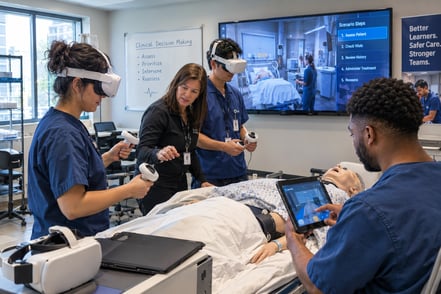
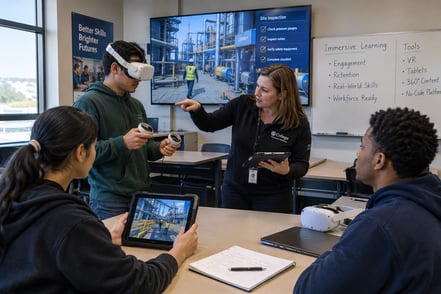
- Immersive training is training that creates realistic context, interactive decisions, and practice that looks like the job, whether that happens on a headset, a tablet, or a laptop.
This is why VR vs immersive training is the wrong debate. VR can be immersive, but immersive is not limited to VR.
In practice, immersive reality means simulation-based learning delivered in the formats your workforce can actually access.
Simulation-based learning is the grown-up version of training
Most enterprise training still behaves like a content library. Scroll, click Next, hope the learner remembers it later.
Simulation-based learning flips that.
Instead of telling learners what to do, it lets them practice doing it. It creates decision points. It rewards correct sequencing. It surfaces hidden assumptions. It makes mistakes safe, so performance becomes safer later.
This is where immersive training stops being “engaging” and starts being operational.
And there is evidence that immersion can change learning outcomes. PwC’s research on VR soft skills training found learners in VR completed training up to 4x faster than classroom learners and reported higher emotional connection to the content compared with classroom and e-learning approaches. (PwC)
Take the lesson, not just the headline. The lesson is not “VR wins.” The lesson is “practice in realistic context drives better learning.” That principle can be delivered across devices, especially when you build the program as a platform, not a one-off VR experience.
Multi-device training deployment is not a feature. It is a scaling strategy.
Enterprises do not have one kind of learner.
You have:
- desk workers with dual monitors
- supervisors on tablets
- field teams on rugged devices
- new hires using whatever they were handed on day one
- contractors who cannot install half your software stack
A training approach that depends on one device type is fragile. It fails at the edges, and the edges are where real operations live.
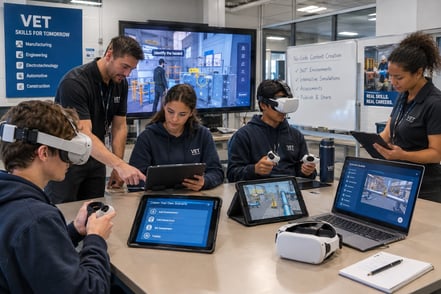
That is why multi-device training deployment is becoming the default expectation. The winning training programs are device-agnostic by design: desktop, tablet, mobile, and yes, VR when it earns its keep.
This is what “immersive reality” really means: training that travels.
The L&D tech stack evolution is shifting from “content systems” to “creation and measurement systems”
Traditional L&D stacks were built around management: LMS, compliance tracking, course catalogs.
Modern stacks need three additional muscles:
- Rapid creation
The organization changes faster than traditional course production cycles. Procedures update. Equipment changes. Regulations shift. Your training has to keep up.
- Performance measurement
Completion is not the goal. Competence is the goal. That requires measurement that captures decisions, errors, retries, time-to-proficiency, and scenario outcomes.
- Distribution across devices
If your training cannot be deployed where the work happens, you do not have a training strategy. You have a content archive.
This is the core of L&D tech stack evolution: from storing content to continuously creating, deploying, and improving learning experiences like a product team would.
Gartner’s public materials on spatial computing and strategic technology trends point toward more immersive, blended digital experiences and new frontiers of human-machine interaction, reinforcing that “immersive” is becoming a broader computing shift, not a VR niche. (Gartner)
No-code immersive content is how you escape the “innovation bottleneck”
Here is the part nobody loves to say out loud: most immersive initiatives die because only a few people can build them.
If your immersive training depends on specialized developers or an external studio, you will move slowly, ship rarely, and never scale beyond the pilot.
That is why no-code immersive content matters. It is not a convenience, it is a growth lever. No-code platforms let L&D teams and subject matter experts build, iterate, and publish without waiting in line behind engineering priorities.
And the broader market is moving toward scalable authoring. Industry market trackers report rapid growth in e-learning authoring tools, reflecting demand for faster content creation in corporate training. (Research and Markets)
No-code is how immersive reality becomes operational reality.
So what does “immersive training platform” actually mean?
A true immersive training platform is not a headset app factory. It is a system that supports:
- simulation-based learning with branching decisions and realistic workflows
- cross-platform delivery so training works on desktop and tablet by default
- VR as an optional layer for high-stakes moments where immersion adds measurable value
- rapid authoring and iteration so content stays current
- analytics that matter so you can prove impact, not just engagement
- repeatable deployment across teams, regions, and business units
In other words, it is built for scale.
The new category is not “VR training.” It is “immersive reality.”
If your organization is still thinking in terms of “our VR program,” you are probably trapped in a silo.
Silos create pilot success and enterprise failure.
Immersive reality breaks the silo by treating immersive learning as a capability, not a gadget. It is how you standardize training across a distributed workforce. It is how you reduce ramp time. It is how you turn tribal knowledge into repeatable performance.
And it gives you the freedom to use VR where it belongs: in the moments that justify the extra immersion, not as the mandatory starting line.
Where Facilitate fits (and why this positioning is the right hill to die on)
The category-defining claim for Facilitate is simple: immersive training should be scalable, measurable, and device-agnostic.
That positions Facilitate as one of the few immersive training platforms that helps companies move beyond VR-only thinking into simulation-based learning across platforms.
This is the pragmatic, enterprise-ready story:
- Meet learners where they are today on desktop and tablet.
- Prove outcomes through measurable simulation-based learning.
- Expand into VR when the organization is ready and the use case demands it.
- Build fast with no-code immersive content so you scale beyond the pilot.
The future of enterprise training is not virtual.
It is immersive reality, and the companies that adopt this mindset now will be the ones whose training actually reaches everyone, not just the lucky few who got a headset demo.



Comments