Why Organizations Are Rethinking Safety Training Through Immersive Learning and Operational Rehearsal
TL;DR
Industrial organizations are facing a growing realization: traditional safety training methods are no longer enough to prepare workers for increasingly complex and high-risk operational environments.
Across energy, manufacturing, aviation, healthcare, construction, and other industrial sectors, organizations are shifting toward immersive learning and interactive simulation training to improve hazard recognition, operational awareness, and workforce preparedness.
Industrial safety is evolving from passive compliance-based instruction toward experiential workforce development where employees actively rehearse procedures, emergency response, and hazard scenarios before entering live environments.
As operational complexity and workforce turnover continue to rise, immersive industrial safety training is becoming a foundational part of workforce readiness and operational resilience.
The Nature of Industrial Risk Is Changing
Industrial environments have always involved risk.
But modern operational environments are becoming more dynamic, interconnected, and complex than ever before.
Energy organizations are balancing aging infrastructure with renewable integration and advanced grid systems. Manufacturers are operating highly automated production environments alongside workforce transitions. Construction firms manage constantly changing jobsites while facing labor shortages and compressed project timelines. Aviation and healthcare organizations continue operating inside systems where procedural precision and human reliability are essential.
At the same time, organizations are onboarding employees faster while experienced workers continue retiring across many sectors.
This creates a difficult operational challenge.
Workers are expected to navigate increasingly complex environments while often having less real-world operational exposure than previous generations of employees.
Historically, much industrial expertise was transferred gradually through mentorship, repetition, and years of field experience. New employees learned situational awareness by spending extended periods inside operational environments alongside experienced personnel.
That model is becoming harder to sustain.
Organizations today need workforce training systems that can accelerate readiness without compromising safety.
This is why industrial safety training is rapidly evolving beyond traditional compliance models.
Why Traditional Safety Training Often Falls Short
For decades, industrial safety training has largely focused on information delivery.
Employees attend safety briefings, review procedures, complete compliance modules, watch instructional videos, and pass assessments designed to confirm knowledge retention.
Those systems remain important.
But information alone rarely prepares employees for operational reality.
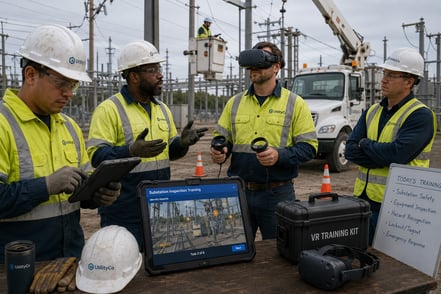
Reading about electrical hazards is not the same as recognizing dangerous conditions inside a live substation environment. Watching a confined space training video does not replicate the psychological and environmental pressures workers experience onsite. Completing lockout/tagout coursework cannot fully prepare someone for procedural execution under operational stress.
The problem is not necessarily that traditional safety training is incorrect.
The problem is that safety performance itself is behavioral.
Employees must be able to:
- Recognize hazards contextually
- Make decisions under pressure
- Navigate environmental distractions
- Follow procedures consistently
- Communicate effectively
- Respond to unexpected situations
These are not skills developed solely through passive instruction.
They are developed through experience.
Why Experiential Learning Improves Safety Preparedness
The most effective safety learning has always involved practical experience.
Workers become safer not simply because they know procedures theoretically, but because they have rehearsed them repeatedly under realistic conditions.
This principle already exists across many high-performance professions.
Pilots train continuously in flight simulators before encountering emergencies in live aircraft. Medical professionals rehearse procedures before performing them under pressure. Military teams repeatedly train in realistic environments before deployment.
Industrial organizations are increasingly applying the same philosophy to workforce safety.
Immersive learning and interactive simulation training allow employees to safely practice:
- Hazard recognition
- Emergency response
- Lockout/tagout procedures
- Equipment shutdowns
- Confined space protocols
- Maintenance workflows
- Crisis communication
- Environmental safety procedures
Before they encounter these situations in live operational environments.
This changes safety training fundamentally.
Instead of treating safety as a static compliance exercise, organizations can create experiential rehearsal environments where employees actively develop operational familiarity and situational awareness.
The learning becomes behavioral rather than purely informational.
The Rise of Simulation-Based Industrial Safety Training
One of the biggest limitations of traditional safety programs has always been realism.
Many of the scenarios organizations most need employees to prepare for are difficult, dangerous, expensive, or operationally disruptive to recreate live.
Emergency shutdowns, hazardous material releases, confined space incidents, electrical failures, and equipment malfunctions all carry inherent risk.
As a result, employees often receive theoretical instruction for situations they may never realistically practice until an actual emergency occurs.
Interactive simulation training changes this dynamic by allowing organizations to recreate hazardous scenarios safely inside immersive digital environments.
Workers can rehearse:
- Emergency evacuations
- Hazardous equipment procedures
- High-voltage safety protocols
- Radiation exposure scenarios
- Fall prevention workflows
- Fire response procedures
- Environmental hazard situations
Repeatedly and safely.
This type of rehearsal is especially valuable because operational readiness depends heavily on familiarity under pressure.
Employees who have already experienced realistic procedural scenarios through immersive learning often respond more confidently and consistently when similar situations emerge in the real world.
Simulation-based safety training helps compress the gap between theoretical preparedness and operational behavior.
Industrial Safety Is Increasingly a Human Performance Issue
Another major shift happening across industrial safety is the growing recognition that many incidents involve human performance factors as much as technical failures.
Organizations are increasingly analyzing how:
- Cognitive overload
- Fatigue
- Communication breakdowns
- Environmental distractions
- Inexperience
- Situational ambiguity
- Stress responses
Influence operational outcomes.
This has expanded the conversation around safety training significantly.
Industrial safety is no longer viewed solely as procedural compliance.
It is increasingly connected to:
- Human performance optimization
- Workforce readiness
- Situational awareness
- Decision-making capability
- Operational confidence
- Behavioral consistency
Immersive experiential learning is powerful because it allows organizations to train not only procedural knowledge, but also operational behavior.
Workers learn how environments feel, how pressure impacts decision-making, and how procedures unfold in realistic contexts before encountering actual operational consequences.
That behavioral preparation may become one of the most important safety advantages organizations can develop.
Why Industrial Safety Training Is Becoming Continuous
Historically, safety training often followed a relatively linear structure:
- Onboarding
- Certification
- Annual refreshers
- Incident-based retraining
But operational environments evolve continuously.
Procedures change. Facilities expand. Equipment upgrades occur. Regulations shift. Workforce compositions change.
As a result, industrial safety can no longer depend entirely on static training cycles.
Organizations increasingly need adaptive workforce rehearsal systems capable of evolving alongside operational conditions.
Immersive learning platforms make this possible.
Simulation-based environments can be updated continuously to reflect:
- New operational procedures
- Emerging risks
- Facility changes
- Updated compliance requirements
- New equipment deployments
This creates a much more agile and operationally aligned approach to workforce safety preparedness.
The organizations investing in immersive industrial safety today are not simply modernizing training.
They are building continuously adaptive safety cultures.
Final Thoughts
Industrial safety is undergoing a profound transformation.
The shift is not simply technological.
It is philosophical.
Organizations are moving away from viewing safety training as a compliance requirement and toward understanding it as a workforce readiness capability built through experience, rehearsal, and operational familiarity.
Immersive learning and interactive simulation training are powerful because they allow organizations to safely recreate complexity before operational consequences emerge.
Employees gain confidence before entering hazardous environments. Teams rehearse emergency procedures before crises occur. Organizations strengthen safety culture through realistic operational preparation rather than passive instruction alone.
The future of industrial safety will not be defined solely by how effectively organizations distribute procedures.
It will increasingly be defined by how effectively they prepare people to perform safely inside complex environments where those procedures matter most.
FAQ
What is industrial safety training?
Industrial safety training prepares employees to identify hazards, follow procedures, prevent incidents, and respond effectively in high-risk operational environments.
Why is immersive learning effective for industrial safety?
Immersive learning allows employees to practice safety-critical procedures and hazard scenarios in realistic environments without exposing people or operations to unnecessary risk.
What is simulation-based safety training?
Simulation-based safety training places employees inside realistic digital environments where they actively rehearse procedures, hazard recognition, emergency response, and operational decision-making.
What industries use immersive industrial safety training?
Industries including energy, manufacturing, aviation, healthcare, construction, and education use immersive safety training for workforce preparedness, hazard awareness, onboarding, and operational readiness.
Why are organizations moving beyond traditional safety training?
Traditional safety training is often passive and disconnected from operational reality. Experiential learning improves preparedness through realistic rehearsal and contextual learning.
Can immersive safety training integrate with LMS systems?
Yes. Many immersive learning platforms support SCORM and xAPI integration with enterprise LMS and workforce analytics systems.
What are the business benefits of immersive industrial safety training?
Organizations use immersive safety training to improve hazard recognition, strengthen safety culture, accelerate onboarding, improve workforce confidence, reduce operational risk, and standardize safety procedures.
Does immersive industrial safety training require VR developers?
No. Modern no-code immersive learning platforms allow organizations to create and manage safety simulations internally without requiring software development expertise.



Comments