TL;DR: Utility companies are being asked to do more with fewer experienced workers. Aging infrastructure, retiring experts, new technologies, and increasing regulatory demands have exposed weaknesses in traditional training programs. The biggest challenge isn't finding more training—it's delivering better training. Organizations that embrace immersive, hands-on, device-agnostic learning are building safer, more confident workforces while reducing onboarding time and preserving critical institutional knowledge.
The utility industry has always been built on experience.
For generations, knowledge passed from veteran employees to apprentices through years of field work. New employees learned by observing experienced crews, asking questions, and gradually taking on greater responsibility. Procedures changed slowly, equipment remained in service for decades, and careers often lasted thirty or forty years within the same organization.
That model no longer reflects today's reality.
Utility companies now face one of the largest workforce transitions in modern history. Experienced employees are retiring in record numbers, infrastructure is becoming increasingly sophisticated, and customer expectations for reliability have never been higher. At the same time, organizations must prepare new employees to safely perform technically demanding work much faster than ever before.
These changes have elevated utility training challenges from an operational concern to a strategic priority.
Training is no longer simply about compliance. It is about ensuring the workforce has the skills, confidence, and knowledge needed to safely operate the infrastructure that millions of people depend on every day.
The Industry Is Losing Its Most Valuable Asset
The greatest asset inside any utility isn't a power plant, substation, or fleet of service vehicles.
It's the people who know how everything works.
Experienced operators and field technicians possess knowledge that rarely appears in manuals. They understand subtle warning signs, recognize unusual equipment behavior, and know how to respond when situations don't follow standard operating procedures.
Unfortunately, much of this knowledge leaves when employees retire.
Utilities across the country are facing an unprecedented transfer of institutional knowledge, yet many organizations still rely on documentation and classroom presentations as their primary methods of preserving expertise.
Written procedures explain what to do.
Experience teaches how to do it well.
That distinction has become increasingly important.
The Technical Skills Gap Keeps Expanding
Modern utilities operate in a far different environment than they did even ten years ago.
Employees now work with:
- Smart grid technologies
- Renewable energy systems
- Battery storage
- Advanced metering infrastructure
- Digital monitoring platforms
- SCADA systems
- Automation
- Cybersecurity protocols
The technical skills gap isn't simply about hiring engineers.
Every field employee is expected to understand more technology than ever before.
Meanwhile, organizations compete with manufacturing, telecommunications, construction, transportation, and technology companies for many of the same skilled workers.
Finding experienced candidates has become increasingly difficult.
Developing them internally has become essential.
Safety Training Has Become More Complex
Utilities have always emphasized safety.
But today's work environments introduce additional complexity.
Employees often move between aging infrastructure and newly modernized systems. They work around energized equipment, confined spaces, underground utilities, heavy machinery, gas distribution systems, and hazardous weather conditions.
Every procedure matters.
The challenge is that classroom instruction alone rarely prepares employees for high-pressure situations.
People build confidence through practice.
Yet real-world practice can be expensive, disruptive, or dangerous.
Organizations increasingly recognize that employees need opportunities to safely make mistakes before entering the field.
That's one reason experiential learning continues gaining momentum throughout the utility industry.
Compliance Isn't the Same as Competence
Most utilities have robust compliance programs.
Employees complete annual safety training.
They review procedures.
They pass required assessments.
Those activities remain important.
But compliance measures participation.
It doesn't necessarily measure readiness.
An employee who completes a course today may struggle to apply those procedures six months later during an emergency restoration effort.
Training should answer a more meaningful question:
Can this employee safely perform the work?
Modern learning strategies increasingly focus on competency rather than completion.
Utility Workforce Development Must Accelerate
Hiring challenges have fundamentally changed utility workforce development.
Organizations no longer have the luxury of assuming every new employee arrives with years of relevant experience.
Instead, they must shorten the journey from hiring to productivity.
That requires training programs capable of teaching practical skills quickly while maintaining high safety standards.
Companies that reduce onboarding time without sacrificing quality gain significant operational advantages.
Training becomes a competitive advantage instead of an administrative requirement.
Traditional Training Doesn't Match Modern Learners
Today's workforce consumes information differently than previous generations.
Interactive technology has shaped how people solve problems and acquire new skills.
Employees increasingly expect learning experiences that allow them to participate rather than simply observe.
Unfortunately, much of today's utility training still relies heavily on presentations, videos, and lengthy documentation.
Those methods communicate information.
They don't necessarily build confidence.
People remember what they experience far longer than what they read.
That simple truth is changing how learning programs are designed.
Training Must Keep Pace With Operational Change
Utilities continuously update procedures.
Equipment evolves.
Regulations change.
Internal best practices improve.
Yet many organizations still depend on lengthy content development cycles or third-party vendors whenever training requires updates.
This creates a dangerous gap between operations and learning.
By the time revised courses become available, procedures may already have changed again.
Leading organizations are shifting toward training platforms that allow internal experts to rapidly create and update content themselves.
Knowledge stays current because the people closest to the work control the learning process.
Employee Retention Begins With Better Learning
Hiring skilled employees is expensive.
Replacing them is even more expensive.
One of the least discussed contributors to employee retention in utilities is the quality of onboarding and professional development.
Employees who feel unsupported often become disengaged.
Employees who receive meaningful, practical training become confident more quickly.
Confidence leads to stronger performance.
Strong performance leads to greater job satisfaction.
Training doesn't simply prepare employees for work.
It demonstrates that the organization is invested in their long-term success.
The Future of Utility Company Management
Progressive utility company management teams are beginning to view training differently.
Rather than asking how many employees completed courses, they're asking how prepared employees are to perform critical tasks safely.
Rather than measuring attendance, they're measuring competency.
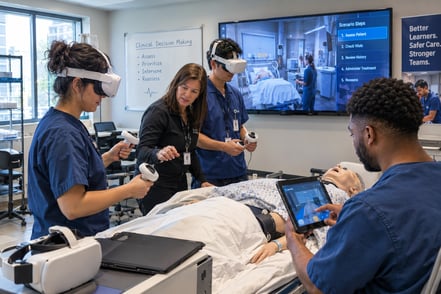
Rather than relying exclusively on classroom instruction, they're blending instructor-led learning with immersive, hands-on experiences that reinforce knowledge through practice.
The objective isn't replacing instructors.
It's giving instructors better tools.
Why Immersive, Device-Agnostic Training Is Gaining Momentum
Many organizations mistakenly believe immersive learning requires purchasing hundreds of VR headsets.
That's no longer true.
Today's immersive training platforms increasingly support desktops, laptops, tablets, mobile devices, and virtual reality from a single content library.
This device-agnostic approach removes many of the barriers that once slowed adoption.
Employees can begin training from virtually anywhere.
Organizations scale learning without replacing existing hardware.
Subject matter experts can update content as procedures evolve.
Most importantly, employees gain practical experience before encountering similar situations in the field.
The technology isn't the real innovation.
The learning experience is.
Building the Utility Workforce of the Future
The challenges facing utilities aren't temporary.
Retirements will continue.
Infrastructure modernization will continue.
Demand for electricity will continue growing.
Training must evolve alongside the industry.
Organizations that continue relying exclusively on static courses and annual compliance sessions will struggle to prepare employees for increasingly complex work.
Those that embrace interactive, experiential, and easily updated learning will build safer, more capable, and more resilient workforces.
The future of utility training isn't about delivering more information.
It's about creating more capable people.
Frequently Asked Questions
What are the biggest utility training challenges today?
The biggest challenges include retiring employees, the growing technical skills gap, preserving institutional knowledge, improving safety training, maintaining compliance, onboarding new hires faster, and delivering consistent training across distributed workforces.
Why is utility workforce development becoming more important?
Utilities face increasing competition for skilled workers while experienced employees retire. Strong workforce development helps organizations build internal talent, reduce onboarding time, improve safety, and prepare employees for modern infrastructure.
How does immersive learning improve energy sector training?
Immersive learning gives employees realistic practice in safe, controlled environments. Instead of simply reading procedures, learners actively perform tasks, improving confidence, engagement, and long-term retention.
Does immersive utility training require virtual reality?
No. Many modern learning platforms deliver immersive experiences across desktops, laptops, tablets, mobile devices, and VR headsets, allowing organizations to choose the deployment model that best fits their workforce.
How can utility companies improve employee retention?
Providing engaging onboarding, continuous professional development, practical skills training, and opportunities for career growth helps employees feel prepared and supported, improving both performance and long-term retention.





Comments