As immersive technologies become more accessible and cost-effective, organizations across sectors are asking a common question: What’s the difference between AR and VR—and which is better for training?
The answer depends on what you’re trying to teach, when it needs to be learned, and how safely and effectively you can deliver that experience. In this post, we break down the differences, use cases, and how both technologies are shaping the future of workforce training.
Layman's Definitions: AR vs. VR
Augmented Reality (AR) overlays digital information onto the real world. Using smartphones, tablets, or AR headsets like the HoloLens or RealWear HMT-1, users see their physical surroundings enhanced with text, images, 3D models, or animations.
Virtual Reality (VR), on the other hand, replaces the real world entirely with a simulated environment. When using a VR headset, such as the Meta Quest or Vive Focus, the learner is fully immersed in a digitally created space designed to mimic real or imaginary scenarios.
In short:
- AR = Real world + digital overlays
- VR = Fully virtual environment
When to Use AR: Real-Time, In-the-Flow Support
AR is ideal for just-in-time training and real-time task support. It excels in scenarios where the learner needs to:
- Follow step-by-step instructions on the job
- Troubleshoot unfamiliar equipment
- Access remote expert assistance via "see-what-I-see" technology
- View overlays of technical data, diagrams, or 3D parts during a live task
Example Use Cases for AR in Training
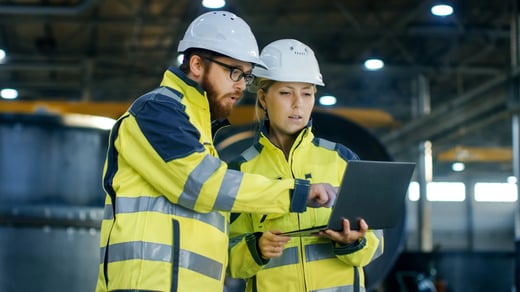
- Electric utilities: Field techs using AR headsets to get guided instructions on transformer maintenance.
- Manufacturing: Assembly line workers accessing visual overlays for new or complex product configurations.
- Oil & Gas: Technicians receiving remote support during offshore inspections or hazardous materials handling.
AR becomes significantly more powerful when integrated with AI. By linking an AR interface to a smart knowledge base, workers can ask questions and get contextual, voice-activated support while staying hands-free and heads-up in the field.
When to Use VR: Immersive, Risk-Free Rehearsal
VR is optimal for "set piece" training before someone ever steps into the field. It is particularly valuable when the goal is to:
- Practice hazardous or high-risk tasks in a safe, simulated environment
- Build muscle memory for procedures
- Teach protocols that require perfect execution (e.g., Lockout/Tagout, emergency evacuation)
- Recreate rare or unpredictable events (e.g., gas leak, explosion, system failure)
Because VR does not rely on the real world as its backdrop, it allows for fully controlled and repeatable experiences. Learners can make mistakes, try again, and build confidence without consequence.
Example Use Cases for VR in Training
- Energy & Utilities: Simulating substation failures or emergency shutdowns.
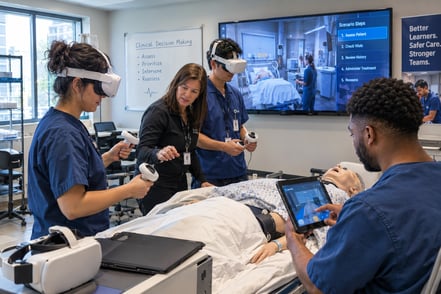
- Healthcare: Rehearsing patient intake, triage, or critical care protocols.
- Construction: Training crane operators or site managers on fall prevention and hazard recognition.
AR vs VR: Which is Better for Training?
It’s not a competition—it’s a toolkit. Each modality solves different learning challenges:
|
Use Case
|
Best Technology
|
Why
|
|
On-the-job assistance
|
AR
|
Contextual, real-time, hands-free
|
|
Safety & emergency training
|
VR
|
Safe, repeatable simulations
|
|
Equipment troubleshooting
|
AR
|
Visual overlays + AI for knowledge gaps
|
|
Procedure mastery (e.g., LOTO)
|
VR
|
Immersive, interactive repetition
|
|
Soft skills or customer service
|
VR
|
Controlled roleplay with avatars
|
Blended Learning: The Future is Hybrid
The most effective training programs are increasingly blended. For example, a new employee might:
- Learn basic procedures in VR before starting work
- Use AR for live task support in the field
- Return to VR to rehearse rare or high-stakes scenarios
Platforms like Facilitate are helping organizations combine these modalities with no-code authoring tools, allowing subject matter experts to build both AR-compatible and VR-ready content quickly and cost-effectively.
Final Thought: Fit the Tech to the Task
In high-consequence sectors like energy, utilities, and healthcare, the question isn't "Which tech is better?" but rather, "What does my workforce need to do, know, or feel confident about—and which modality delivers that best?"
The smart organizations aren't choosing between AR and VR. They're choosing both—intelligently, strategically, and always in service of safer, faster, more effective training.




Comments