


In the high-stakes world of chemical and petrochemical manufacturing, emergency preparedness isn’t optional—it’s mission-critical. Whether it’s a hazardous material spill, toxic gas release, equipment malfunction, or full-scale explosion scenario, the consequences of underprepared personnel can be catastrophic.
While many organizations have emergency response plans on paper—and may even run occasional physical drills—most training fails to fully simulate the intensity, complexity, or urgency of real-world chemical emergencies.
Enter Virtual Reality (VR) training: a modern, scalable solution that lets teams practice high-consequence incidents in fully immersive, interactive simulations. The results? Faster response times, improved safety outcomes, and significantly reduced downtime during real incidents.
Let’s dive into how this technology is reshaping emergency preparedness in the chemical industry—and why forward-thinking safety leaders are embracing it now.
The Limits of Traditional Emergency Drills
Emergency response in the chemical sector is difficult to train for using conventional methods:
- Live drills are expensive, disruptive, and often limited in scope.
- Classroom-based training lacks the realism needed to build confidence or muscle memory.
- Paper checklists may cover protocols but don’t prepare teams for the chaos of a real incident.
Worse still, many chemical plants operate under tight schedules. Shutting down operations for drills can be prohibitively costly—so they often get deprioritized or rushed.
The result? Teams may know what to do in theory but panic under pressure in practice.
How VR Emergency Training Solves These Challenges
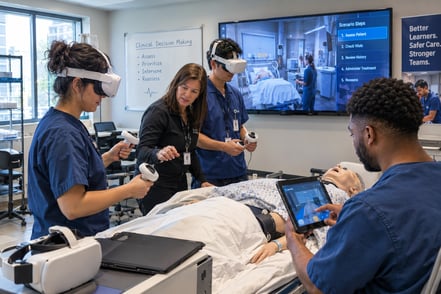
Virtual Reality emergency drills overcome these barriers by creating realistic, repeatable, and risk-free simulations that put workers inside the scenario.
Imagine your plant operators stepping into a simulation where:
- A valve leak triggers a toxic release, and they must locate the source and initiate containment.
- A flash fire erupts in a refinery unit, requiring fast PPE use, evacuation, and communication.
- An explosion drill tests their response time, coordination, and adherence to safety protocols.
These simulations can be tailored to your facility layout, your standard operating procedures, and your specific risk profile—all created in-house with a no-code platform like Facilitate.
Instead of watching videos or flipping through manuals, trainees interact with 3D equipment, make decisions in real time, and face the consequences of their choices in a safe but emotionally resonant environment.
⏱️ Faster, Safer, and More Cost-Effective Training
The ROI of VR emergency preparedness goes beyond just better engagement. Here’s how it translates to operational and financial wins:
✅ 1. Minimize Downtime
Real-world drills often require stopping equipment or evacuating zones. With VR, you can run high-fidelity scenarios without halting production.
✅ 2. Improve Reaction Time
Repetition in simulated high-stress environments builds reflexes and decision-making under pressure—critical when seconds count.
✅ 3. Reduce Onboarding Time
New hires can experience worst-case scenarios before ever stepping into a live plant, accelerating time to readiness and reducing shadowing costs.
✅ 4. Strengthen Compliance
VR logs can track completion, performance, and compliance, helping meet OSHA and EPA training mandates with clear documentation.
✅ 5. Empower Site-Specific Learning
No two chemical plants are the same. Facilitate enables teams to simulate their own layouts, SOPs, and risk environments—ensuring training is highly relevant and immediately applicable.
Real Impact: From Hazard Mitigation to Culture Shift
Organizations that adopt VR emergency training often report culture-level transformation. Safety moves from being an abstract priority to a tangible, visceral experience.
Employees report feeling:
- More prepared to handle real emergencies
- More confident in their roles
- More engaged in safety culture overall
And leadership benefits too—from reduced incidents and insurance claims to stronger regulatory audits and workforce retention.
Why Facilitate Is the Right Partner for Chemical Safety VR
At Facilitate, we specialize in helping high-risk industries like chemical manufacturing bring immersive training in-house—without needing developers or custom code.
Our no-code platform allows EHS teams and SMEs to:
- Rapidly create emergency response simulations
- Customize content for each site or role
- Deploy training across standalone headsets or desktops
- Track progress, completion, and performance via LMS integration
Whether you’re preparing for a routine drill or building a long-term emergency response program, Facilitate makes it easy to build, scale, and evolve your VR training in real-time.
Ready to Simulate the Worst—Before It Happens?
In the chemical industry, it's not if an incident will occur—it's when. The best-prepared teams aren’t just checking boxes. They’re practicing the right moves under pressure, before lives and production are on the line.
Schedule a demo today to see how Facilitate can help your team build confidence, reduce downtime, and take emergency training to the next level—with immersive VR built for the realities of your plant.


Comments