


For years, immersive training was the domain of developers, studios, and specialized technical teams. Creating interactive simulations required 3D artists, programmers, long production cycles, and significant capital investment. As a result, immersive learning—while powerful—remained centralized and slow to scale.
That model is changing.
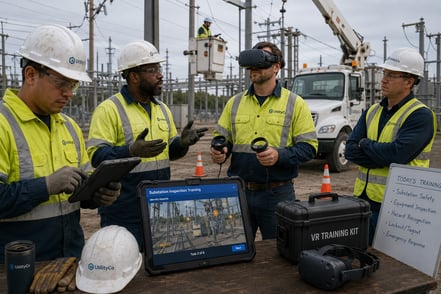
Artificial Intelligence (AI) and no-code immersive platforms are democratizing content creation. Subject Matter Experts (SMEs)—the engineers, safety leaders, field technicians, and operations managers closest to risk—are increasingly empowered to build, adapt, and iterate training experiences themselves.
In the energy sector, where procedures evolve rapidly and knowledge transfer is critical, this shift is transformative.
Research from the Industrial XR Forum shows that training remains the top enterprise use case for immersive technology adoption . Meanwhile, the VR/AR Association highlights immersive learning’s role in improving safety, efficiency, and workforce preparedness in complex environments .
The next evolution is clear: immersive training will not be built only by developers. It will be built by experts.
The Old Model: Centralized, Technical, and Slow
Historically, immersive training development followed a familiar pattern:
- A learning need was identified.
- Instructional designers mapped objectives.
- Developers translated the concept into a digital simulation.
- SMEs reviewed and approved the final build.
This workflow had two fundamental limitations:
First, it created distance between operational expertise and content creation.
Second, it introduced long production cycles that made updates costly.
In energy environments—where grid configurations change, compliance frameworks evolve, and new technologies are deployed—speed and agility are critical.
The centralized model struggles to keep up.
Why SMEs Are the Natural Builders of Immersive Training
Subject Matter Experts hold the most valuable training asset in the energy sector: lived operational knowledge.
They understand:
- The real hazards that rarely appear in manuals
- The subtle sequencing that prevents failure
- The decision inflection points under pressure
- The context behind procedural compliance
Yet in traditional immersive workflows, SMEs were consulted—not empowered.
Democratization changes that dynamic.
When no-code immersive platforms and AI-assisted authoring tools converge, SMEs can move from reviewers to creators.
They can:
- Translate field knowledge directly into interactive scenarios
- Update procedures immediately after regulatory changes
- Capture tribal knowledge before retirement
- Prototype training modules rapidly
This reduces friction between expertise and execution.
AI as the Enabler of Democratization
Artificial Intelligence plays a crucial role in lowering technical barriers.
AI can assist SMEs by:
- Converting standard operating procedures into structured interactive flows
- Auto-generating branching logic from decision trees
- Suggesting assessment questions aligned to competency frameworks
- Identifying logical hazard placements in immersive environments
- Scaffolding scenario structure without manual scripting
Instead of writing code, SMEs guide logic.
This dramatically reduces dependency on bespoke development cycles.
Why This Shift Matters in the Energy Sector
Energy operations are complex, regulated, and geographically distributed.
The VR/AR Association notes that immersive methodologies are especially valuable in hazardous and technically intricate environments .
But immersive impact is constrained if content creation cannot scale.
Democratization enables energy organizations to:
- Standardize training across multiple sites
- Localize modules rapidly
- Respond quickly to compliance updates
- Reduce backlog in L&D departments
- Increase internal ownership of training programs
Industrial XR research shows safety, efficiency gains, and cost savings as primary drivers of immersive adoption . Empowering SMEs accelerates these outcomes.
Reducing Reliance on Bespoke Development
Custom immersive modules historically required external studios or internal development teams.
This created:
- High per-module costs
- Long update cycles
- Vendor lock-in
- Slow response to operational change
Democratized immersive platforms—supported by AI—shift control internally.
Organizations can:
- Build modular simulation templates
- Iterate quickly without redevelopment contracts
- Reduce cost per training module
- Scale content creation across departments
Instead of a few large custom builds, enterprises can deploy many smaller, agile simulations.
Capturing Tribal Knowledge Before It Walks Out the Door
Workforce transition is a pressing issue in energy.
As experienced operators retire, institutional knowledge risks disappearing with them.
When SMEs can author interactive simulations directly, organizations can:
- Capture nuanced operational insights
- Preserve context-specific decision-making
- Document real-world edge cases
- Build onboarding modules grounded in lived experience
The result is not just training—it is institutional continuity.
Maintaining Quality While Expanding Access
Democratization does not mean lowering standards.
The VR/AR Association emphasizes the importance of strong instructional design foundations .
AI-assisted tools can support SMEs by:
- Recommending structured learning objectives
- Ensuring alignment with compliance frameworks
- Highlighting potential cognitive overload
- Guiding scenario flow logic
The future is collaborative: SMEs provide operational expertise, AI supports structure, and learning leaders maintain oversight.
Interactive Training Beyond Headsets
Importantly, democratized immersive training is not limited to VR head-mounted displays.
SME-created content can be deployed through:
- Desktop-based interactive simulations
- 360° procedural walkthroughs
- Hybrid immersive ecosystems
- Blended digital learning platforms
The focus shifts from hardware dependency to capability enablement.
Strategic Implications for Energy Leaders
Energy leaders should ask:
- How quickly can our training evolve with operations?
- Are our SMEs empowered to contribute directly to training creation?
- Are we dependent on external vendors for every content update?
- How are we capturing institutional knowledge before retirement?
Democratization of immersive training aligns with broader digital transformation goals—reducing bottlenecks, increasing agility, and strengthening internal capability.
The organizations that enable SMEs to build interactive learning experiences will scale faster and adapt more effectively.
FAQ
What does “democratization of immersive training” mean?
It refers to enabling subject matter experts—not just developers—to create and update interactive training experiences.
How does AI support SME-led content creation?
AI assists by automating scenario scaffolding, branching logic, and assessment alignment—reducing technical barriers.
Why is this important for the energy sector?
Because energy operations change rapidly and rely heavily on specialized expertise. Faster content iteration reduces risk and improves compliance .
Does democratization reduce training quality?
Not when paired with strong instructional design oversight and AI-supported structure .
Is this limited to VR headsets?
No. SME-created immersive content can be deployed through desktop simulations, 360° environments, and blended interactive platforms.
Comments