AI is rapidly becoming a core part of learning and development—but much of the conversation is still driven by hype rather than practical application.
In reality, AI is not replacing training teams or automating learning entirely. Its primary value lies in accelerating how training is created, updated, and scaled.
Organizations—especially in complex industries like energy—are using AI today to:
- Speed up content creation and reduce bottlenecks
- Generate and expand training scenarios
- Keep training aligned with evolving procedures and regulations
- Enable subject matter experts (SMEs) to contribute directly
- Shift L&D teams toward more strategic, high-impact work
When combined with interactive simulation training, AI helps organizations move from static, slow-moving training programs to dynamic, continuously evolving learning systems.
The Reality Behind AI in Training
Everyone is talking about AI in training—but very few teams are actually using it effectively.
Across conferences, boardrooms, and industry discussions, artificial intelligence has quickly become the dominant theme in learning and development. Yet for many organizations—particularly those operating in high-risk, operationally complex environments—the conversation still feels abstract.
There’s no shortage of bold claims. AI will transform learning. AI will automate training. AI will replace traditional roles. But beneath the noise, a more grounded reality is emerging.
AI is not replacing training teams. It is removing the friction that has always slowed them down.
To understand its real impact, it’s important to move beyond the extremes. On one side, AI is often overhyped as a fully autonomous solution capable of replacing human expertise. On the other, it’s dismissed as little more than a content-generation tool. In practice, it sits somewhere in between—less revolutionary on its own, but highly powerful when embedded into how training actually works.
At its core, AI acts as an acceleration layer. It doesn’t replace subject matter expertise, instructional design, or operational context. Instead, it enhances them by enabling teams to move faster, iterate more frequently, and scale training more effectively.
Where AI Is Delivering Real Value
This shift is already visible in how training content is created. Traditionally, development cycles have been long and resource-intensive, requiring coordination between instructional designers, subject matter experts, and multiple review stages. AI changes the starting point. Rather than building from scratch, teams begin with a structured draft—whether that’s a lesson outline, a scenario, or a set of learning objectives—and refine from there. The result is not just speed, but momentum.
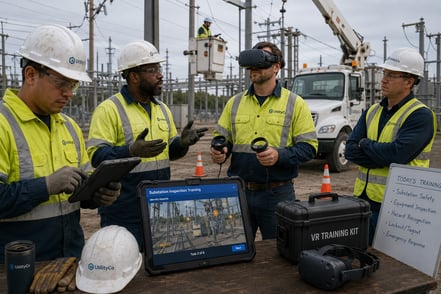
The impact becomes even more significant when applied to scenario-based and simulation training. In industries where safety and operational readiness are critical, the ability to train against realistic scenarios is essential. AI can support the creation of these scenarios by expanding edge cases, generating variations, and helping teams think through situations that may not occur frequently—but carry high consequences when they do. When paired with interactive simulation environments, this enables organizations to move beyond static training modules and toward systems that evolve alongside real-world operations.
Equally important is the ability to keep training up to date. In sectors like energy, procedures change frequently, regulations evolve, and new technologies are introduced at pace. Traditional training struggles to keep up because updating content can be as resource-intensive as creating it. AI reduces that burden, allowing teams to revise materials, adjust scenarios, and maintain consistency across programs more efficiently. This ensures training reflects how work is actually done—not how it was done months or years ago.
Another critical advantage lies in unlocking the knowledge of subject matter experts. Many organizations rely on experienced workers whose expertise is difficult to capture and even harder to scale. AI helps structure that knowledge into usable formats, making it easier for SMEs to contribute directly without needing formal instructional design training. This supports a broader shift—from centralized content creation to a more distributed, SME-driven model.
Elevating the Role of L&D
A common concern is that AI will reduce the need for learning and development teams. In reality, the opposite is happening.
By removing repetitive and time-consuming tasks—such as drafting, formatting, and basic structuring—AI allows L&D professionals to focus on higher-value work. Strategy, learning design, and performance outcomes become the priority.
Rather than diminishing the role of L&D, AI elevates it.
For energy and industrial organizations, this evolution is particularly important. These sectors face mounting pressure from aging workforces, increasing compliance requirements, and rapid technological change. Training must not only be effective—it must be adaptable, scalable, and closely aligned with real-world environments.
AI, especially when combined with interactive simulation training, provides a path forward. It enables faster development, more relevant experiences, and continuous improvement without the constraints of traditional approaches.
The Bottom Line
AI isn’t a silver bullet—but it is a powerful enabler.
It doesn’t replace expertise, instructional design, or operational knowledge. It enhances them.
AI doesn’t replace training teams—it removes the bottlenecks that slow them down.
And for organizations willing to move beyond the hype, that shift may be the most important one of all.
Key Takeaways
- AI accelerates training creation rather than replacing it
- The biggest impact is reducing content development bottlenecks
- Scenario-based and simulation training benefit significantly from AI
- Training can be updated faster to reflect real-world changes
- SMEs can contribute more easily to training creation
- L&D teams can focus more on strategy and outcomes
- AI works best when combined with interactive simulation training
- The goal is not automation—it’s scalability and adaptability
FAQ: AI in Training
What is AI used for in training today?
AI is primarily used to accelerate content creation, generate training scenarios, support updates to existing materials, and help structure knowledge from subject matter experts into usable training formats.
Does AI replace instructional designers or L&D teams?
No. AI removes repetitive tasks and speeds up workflows, allowing L&D teams to focus more on strategy, learning design, and performance outcomes.
How does AI improve training in high-risk industries like energy?
AI helps create more realistic and varied training scenarios, enables faster updates to safety procedures, and supports scalable training across distributed teams—improving both safety and operational readiness.
Is AI only useful for content generation?
No. While content generation is a key use case, AI also supports scenario design, knowledge capture, training updates, and overall workflow efficiency.
How does AI work with immersive or simulation training?
AI enhances simulation training by enabling faster creation of scenarios, continuous updates, and greater variability in training experiences—making learning more dynamic and aligned with real-world conditions.
What’s the first step to using AI in training?
Start with a focused use case—such as accelerating content creation or updating existing training materials—rather than trying to implement AI across your entire training program at once.



Comments