


The Challenge: Inconsistent Training Across Complex Rail Systems
Rail and locomotive equipment manufacturing is a precision-driven process where even the smallest assembly error can have serious downstream consequences. From electrical wiring and hydraulic systems to air brakes and HVAC units, each subsystem requires precise sequencing, torque, and calibration to meet quality and safety standards.
But in reality, these complex procedures are often passed down through on-the-job coaching or outdated PDFs, leading to inconsistencies between shifts, sites, and teams.
- One team follows a slightly different SOP.
- A contractor misses a torque step.
- A technician misinterprets a wiring diagram.
The result? Rework, QA/QC delays, warranty claims, and safety risks.
In an environment where uptime and safety margins are tight, rail manufacturers need a better way to deliver standardized, repeatable, and scalable training—especially as they onboard new talent amid industry-wide turnover.
The Solution: Virtual Reality Standardization
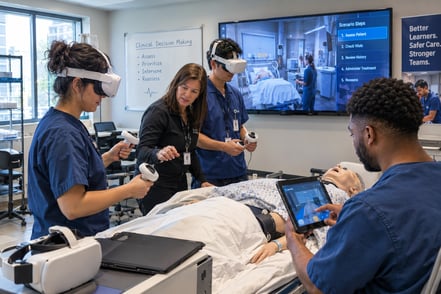
Virtual Reality (VR) training enables manufacturers to create consistent, step-by-step digital training environments for subsystem assembly. Each technician—no matter where they’re located—learns through the same immersive simulation, following approved SOPs in a virtual environment modeled after their actual workstations.
Imagine a new technician being trained on:
- Installing an HVAC unit inside a locomotive cab.
- Calibrating air brake systems.
- Performing cable routing or high-voltage subsystem integration.
In VR, they can interact with 3D components, tools, and checklists while receiving real-time visual and auditory feedback for each action. If they skip a torque sequence or misalign a component, the simulation provides immediate correction—no downtime, no risk, no rework.
No-Code Flexibility for Rapid Adaptation
One of the barriers to scaling immersive learning in manufacturing has been the need for developers to build or edit VR content. Facilitate eliminates that barrier.
With Facilitate’s no-code platform, rail manufacturers can quickly update or build new simulations in-house—no 3D artists or programmers required.
As product designs evolve, or new compliance steps are introduced, SMEs can easily:
- Modify a torque sequence or calibration step.
- Add visual cues or voiceovers for clarity.
- Link lessons to an LMS for tracking progress and completion.
The result? Training that evolves as fast as production does.
ROI: From the Assembly Floor to QA/QC
Implementing VR training doesn’t just improve learning—it drives measurable outcomes across operations:
- Reduced rework: Consistency eliminates costly mistakes.
- Faster onboarding: New hires reach proficiency in half the time.
- Improved QA/QC: Standardized methods translate to cleaner audits.
- Higher engagement: Technicians retain more through hands-on simulation than through reading or observation.
With integration into SCORM/xAPI-compatible LMS systems, training data can be tracked and audited—ensuring accountability, compliance, and continuous improvement.
The Facilitate Advantage
Facilitate empowers rail manufacturers to deliver high-impact immersive training without relying on external developers. With scalable subscription plans and cross-platform support (desktop, headset, or hybrid), organizations can:
- Standardize assembly and inspection training across facilities.
- Reinforce procedural accuracy with real-time feedback.
- Train employees in confined or high-risk areas virtually—safely and cost-effectively.
In an industry where precision equals safety, VR ensures your teams get it right the first time—every time.
Ready to Standardize Rail Training?
Get your teams up to speed faster, safer, and smarter.
Book a demo today to see how Facilitate helps rail manufacturers create, scale, and measure immersive training that drives consistency and performance.

Comments